
The Structural Realignment of Custom Silicon
The architectural foundation of enterprise artificial intelligence hardware has officially shifted. Formally unveiled at Google Cloud Next 2026, the comprehensive deployment of the eighth-generation Tensor Processing Unit lineage signals why mastering Google TPU v8 benchmark metrics is vital for modern infrastructure engineers. Rather than relying on a singular, one-size-fits-all hardware profile to manage the entire machine learning lifecycle, Google has permanently bifurcated its silicon strategy.
By decoupling large-scale foundational model training from continuous multi-agent reinforcement learning, the new lineup optimizes processing budgets. The environment splits into two distinct, independently designed chip variations tailored for separate processing behaviors. This specialized hardware layout allows cloud clusters to maximize operations per joule while preventing traditional computing resource waste.
Whether you are coordinating massive transformer clusters or fine-tuning latency-sensitive Mixture of Experts (MoE) networks, analyzing these newly revealed Google TPU v8 benchmark metrics will help you unlock maximum performance across your enterprise workloads.
The Problem: The Network Wall of Unified Processors
Traditional hyperscaler infrastructure designs are running straight into a severe scaling wall. In the past, running training jobs and real-time user-facing inference on the exact same cluster architecture forced engineers to make massive structural trade-offs. Dense model training demands absolute neighbor-to-neighbor data throughput via closed multi-dimensional rings, whereas conversational agent swarms require massive all-to-all communications to route individual tokens dynamically across active layers.
Using a single network topology for both workloads degrades overall system efficiency. Processors end up sitting idle—starved for information due to network hop delays and high memory latency—while utility expenses balloon.
Reviewing the data within these foundational Google TPU v8 benchmark metrics highlights how Google addresses this exact data bottleneck. By deploying workload-specific silicon configurations, systems can maintain near-linear scaling performance without encountering traditional chip communication caps.
Deep Dive: The Eighth-Generation Dual-Architecture Bifurcation
To successfully orchestrate a distributed enterprise computing run, system administrators must understand the specific differences dividing the two new processing models. The platform categorizes its ninth-decade custom accelerators into training and inference domains:
| Architectural Specification | TPU 8t (Pre-Training Powerhouse) | TPU 8i (Reasoning & Serving Engine) |
| Primary Compute Focus | Massive-scale pre-training and dense embedding lookups. | Multi-agent sampling, auto-regressive decoding, and reinforcement learning. |
| Network Interconnect Topology | 3D Torus Matrix Grid | Hierarchical Boardfly Topology |
| Specialized On-Chip Features | SparseCore Accelerator (Handles irregular data math) | Collectives Acceleration Engine (CAE) |
| High-Bandwidth Memory (HBM) | 216 GB HBM | 288 GB HBM |
| On-Chip SRAM (Vmem Capacity) | 128 MB SRAM | 384 MB SRAM (Tripled for local KV Caches) |
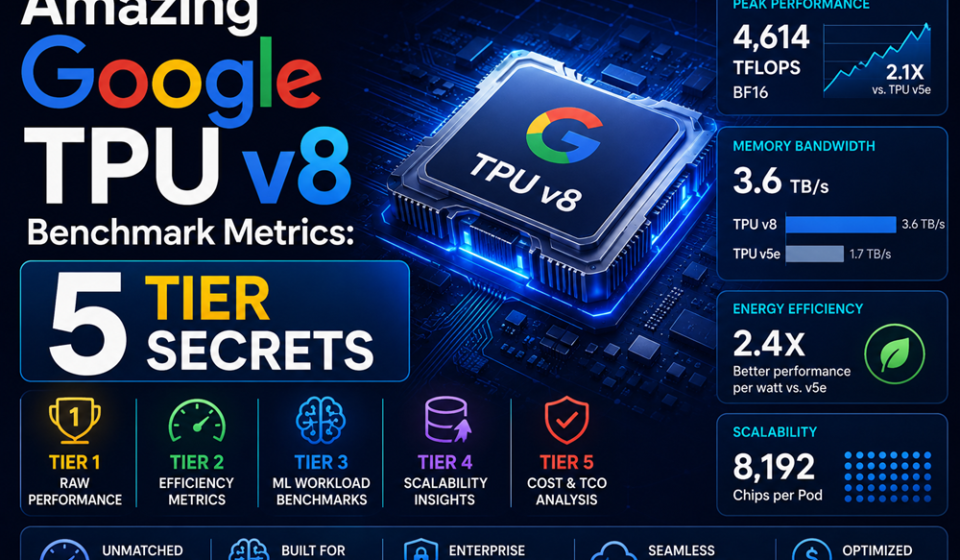
By introducing native 4-bit floating point (FP4) operations, the hardware doubles Matrix Multiply Unit (MXU) throughput while minimizing energy-intensive data movement. According to verified Google TPU v8 benchmark metrics, these design changes allow a single TPU 8t superpod to scale smoothly up to 9,600 liquid-cooled chips, providing 121 ExaFLOPs of aggregate processing capacity.
Step-by-Step Guide: Launching a Distributed Compute Job
Ready to bypass the memory wall, map your custom weights across multi-node fabrics, and deploy your first high-throughput agent training pipeline? Follow this precise sequence to configure your cloud environment safely.
1.Verify Cloud Hypercomputer API Resource Quotas:Environment Check.
Log into your administrative infrastructure dashboard console. Navigate directly to your quotas panel to ensure your environment permissions authorize access to the updated eighth-generation execution nodes.
2.Select the Workload Configuration Node Layer:Step 2.
Determine your immediate operational path. Choose the 3D Torus-backed TPU 8t arrays to run heavy pre-training sequences, or opt for the Boardfly-mapped TPU 8i structures to execute latency-sensitive agent swarms as outlined by recent Google TPU v8 benchmark metrics.
3.Initialize the Open Software Framework Environment:Step 3.
Configure your development toolsets. Leverage native, co-designed software integrations by spinning up optimized runtime environments using JAX, PyTorch via TorchTPU, or the vLLM serving engine.
4.Establish Interchip Interconnect Security Parameters:Step 4.
Configure your automated network isolation parameters. Map your workflows across the Virgo data center fabric to scale up to 134,000 linked nodes with non-blocking bi-sectional data distribution bandwidth.
5.Initialize and Monitor Your Active Goodput Stream:Step 5.
Execute your primary training or inference job. Monitor the built-in real-time telemetry metrics to ensure your job achieves over 97% “goodput” efficiency by utilizing automatic Optical Circuit Switching (OCS) fault rerouting.
Expert Systems Architecture Secrets for AI Hypercomputers
- Leverage Native FP4 Precision Quantization: Do not stall your data paths with heavy 16-bit parameters if accuracy targets allow. Quantize your weights down to native 4-bit floating point to instantly double your compute throughput while saving local buffer space.
- Host High-Capacity KV Caches Entirely On-Silicon: When deploying large Mixture of Experts (MoE) architectures on TPU 8i nodes, utilize the expanded 384 MB on-chip SRAM to store your operational attention metrics locally, breaking past the inference memory wall.
- Isolate Processing Nodes via Axion Host Management: Take advantage of the non-uniform memory architecture (NUMA) isolation brought by the integrated Axion Arm-based CPU hosts to keep individual virtual environments completely clear of neighbor processing noise.
Common Scale-Up Pitfalls to Avoid
- Routing All-to-All MoE Actions Across a 3D Torus Network: Forcing highly distributed token routing patterns through a traditional torus network creates high tail latency. Route conversational token decoding across the Boardfly topology of TPU 8i chips instead.
- Ignoring Local Artifact Storage Throughput Caps: Standard storage setups can quickly starve your high-speed chips during checkpoint saves. Always pair your computing clusters with parallel file systems like Google Cloud Managed Lustre to keep data flowing smoothly.
- Overloading Single-Node Framework Dependencies: Avoid using rigid, closed framework hooks that lock you into one hardware vendor. Build your automation layers using open engines like SGLang and JAX to preserve cross-platform flexibility.
Pros and Cons of the Eighth-Generation Cloud Accelerators
Pros
- Superb Cost Efficiency Gains: Provides up to a 2.7x improvement in training price-performance and an 80% leap in inference value over prior generations.
- Excellent Hardware Reliability: The integration of real-time telemetry and automatic optical switching delivers up to 97% productive computing goodput.
- Outstanding Framework Flexibility: Offers full, native ecosystem support for popular frameworks like PyTorch (TorchTPU), JAX, and vLLM.
Cons
- Aggressive Capacity Planning Needed: Accessing vast superpod architectures requires secured, long-term resource commitments from corporate budgeting squads.
- Bifurcated Codebase Overhead: Splitting development across two distinct chip architectures forces engineering teams to maintain separate optimization paths for training and inference.
Strategic Real-World Enterprise Use Cases
- Autonomous Million-Node Frontier Pre-Training: Advanced research labs connect massive model architectures across global data centers using Pathways, linking over one million accelerators into a single seamless supercomputing fabric.
- Ultra-Low Latency Agent Swarm Coordination: Financial institutions leverage the dedicated Collectives Acceleration Engine (CAE) on TPU 8i instances to run thousands of parallel reasoning loops simultaneously, keeping tail latency to an absolute minimum.
- Massive Reinforcement Learning Trials: Enterprise software operations run continuous reinforcement learning sequences on the eighth-generation hardware, evaluating thousands of complex code reasoning paths near-instantly without typical processing cycle delays.
Hardware Optimization Summary & Tactical Next Steps
Analyzing the technical realities behind the latest Google TPU v8 benchmark metrics signals a permanent evolution away from general-purpose accelerators toward workload-specific cloud computing. By separating heavy training tasks from quick reasoning loops, using native FP4 quantization, and anchoring code networks to open software frameworks, developers gain an incredibly efficient platform. Start your infrastructure upgrade journey today by auditing your active model parameters, configuring an isolated test node, and monitoring your processing throughput to scale securely.
Explore More Google Products & Tools
To see how these new high-speed models fit into Google’s broader software roadmap, check out our comprehensive Google Product Index Categories Hub on the homepage to browse through active enterprise toolsets.
Google Product Index Categories Hub:
https://www.google.com/search?q=https://gproductindex.com/
To track how these new tools fit into the wider landscape of active and legacy applications, you can explore our comprehensive Google Products Database Hub right on our homepage.
Google Products Database Hub:
10. FAQ Schema
What are the main differences between the two chips in the Google TPU v8 benchmark metrics lineup?
The family is explicitly split into the TPU 8t and TPU 8i. The TPU 8t is built for large-scale model pre-training using a 3D Torus layout and SparseCores, while the TPU 8i is optimized for low-latency inference and reasoning using a Boardfly layout and a dedicated Collectives Acceleration Engine.
How does the Boardfly topology improve inference speeds for MoE models?
Traditional 3D Torus systems require data packets to hop across long circular nodes, which slows down all-to-all communication. The Boardfly layout reduces the overall network diameter by over 50%, significantly dropping tail latency so processors spend less time waiting for remote data.
Can I run native PyTorch models on the eighth-generation TPU infrastructure?
Yes. Google has eliminated traditional framework constraints by introducing native support for PyTorch via TorchTPU. This allows developers to run their existing models on TPUs with full support for native features like Eager Mode, alongside JAX and vLLM.