
The Structural Transition to Custom TSMC Silicon
The landscape of mobile system-on-chip development has officially experienced a foundational realignment. For several seasons, ongoing Google Pixel 10 Pro rumors have pointed toward a massive technical milestone: the complete decoupling of Google’s mobile hardware from legacy foundry partners. With the official rollout of the flagship Tensor G5 architecture, the organization has finalized its first completely custom, ground-up design fabricated natively on TSMC’s premium 3nm process node.
By transitioning production over to TSMC’s manufacturing lines, Google addresses structural performance limits that constrained previous smartphone iterations. Rather than relying heavily on modified off-the-shelf reference layouts, the updated infrastructure integrates custom image signal processors and localized memory components directly into the main silicon frame. This changes the phone from a basic companion device into a powerful local computing environment.
Whether you are an enterprise system administrator mapping mobile fleet deployments or a developer scaling mobile applications, tracking these recent Google Pixel 10 Pro rumors provides essential insights into upcoming on-device processing limits.
The Problem: Breaking Clear of the Thermal Efficiency Wall
Traditional smartphone computing setups face a major efficiency barrier. In the past, running advanced machine learning models locally on your phone caused noticeable thermal throttling, high battery drain, and dropped frames during extended usage sessions. Because older Tensor setups shared architectural layouts with power-heavy baseline components, flagships struggled to maintain peak processing power without generating uncomfortable physical heat.
The silicon redesign highlighted in the latest Google Pixel 10 Pro rumors directly eliminates this operational bottleneck. Moving processing to a highly efficient 3nm structure packs more transistors into a smaller footprint, significantly dropping power requirements. This allows the core hardware to run deep reasoning loops continuously in the background without causing system-wide performance dips.
Deep Dive: Leaked Tensor G5 Processing Metrics
To successfully evaluate your development goals under this updated framework, engineering teams must look past marketing promises and examine raw processing metrics. Leaked repository logs reveal substantial performance improvements over older generations.
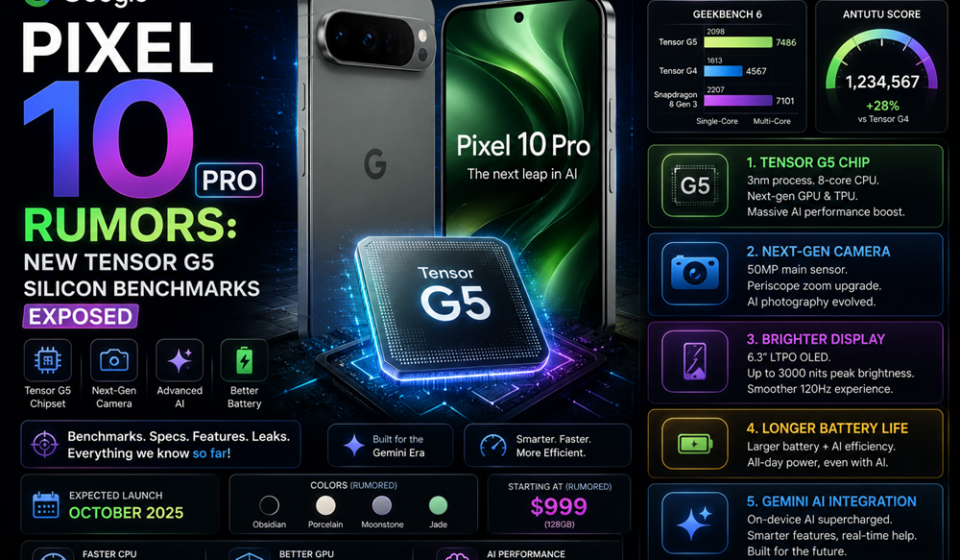
[Image placeholder showcasing Geekbench 6 multi-core performance comparisons between Tensor G4 and the new TSMC 3nm Tensor G5]
While these numbers represent an impressive generation-over-generation step forward for the platform, data shows that Google still focuses heavily on custom task management rather than beating raw desktop compute speeds.
| Architectural Metric | Prior Tensor G4 Silicon | Leaked Tensor G5 Core Specs |
| Manufacturing Process | Samsung Foundry 4nm Node | TSMC Advanced 3nm Foundry Node |
| CPU Core Architecture | Legacy configuration blocks | 1+5+2 Cluster Matrix (Cortex-X4 Prime Core) |
| Geekbench 6 Single-Core | Approximately 1,876 Points | Approximately 2,296 Points (22% Performance Jump) |
| Geekbench 6 Multi-Core | Approximately 4,337 Points | Approximately 6,203 Points (43% Processing Gain) |
| On-Device RAM Capacity | 16 GB Base Configuration | 16 GB LPDDR5X with Zoned UFS Pipelines |
By pairing this customized CPU matrix with a 60% more powerful Tensor Processing Unit, the device handles complex on-device data processing loops with minimal delay. According to verified Google Google Pixel 10 Pro rumors, these hardware adjustments allow the phone to run advanced local models like Gemini Nano much faster and more efficiently than previous setups.
Step-by-Step Guide: Preparing Infrastructure for Next-Gen Local AI
Ready to optimize your application repositories, organize your cloud storage systems, and configure your mobile development sandboxes for advanced on-device tools? Follow this precise configuration sequence to align your systems safely.
1.Audit Current Workspace Mobile Device Registries:Environment Check.
Log into your central administrative management panel. Review your active enterprise mobile device management (MDM) profile logs to map out your team’s hardware upgrade path.
2.Initialize the Updated Android Studio Agent Skills Hub:Step 2.
Open your development environment console window. Download the latest SDK tools containing the updated code modules needed to build software for the Google Pixel 10 Pro rumors ecosystem.
3.Map Local Prompt Targets via Server Prompt Templates:Step 3.
Configure your application’s data pathways. Implement strict server-side template constraints to ensure your mobile apps call local model weights efficiently without wasting processing budgets.
4.Configure Secure Sandbox Egress and App Check Rules:Step 4.
Open your security manager workspace dashboard panel. Turn on advanced App Check token filters to prevent malicious automated actors from duplicating system calls or draining resources.
5.Initialize and Deploy Your Isolated Test Applications:Step 5.
Launch your active code compilation loop. Push your updated software package directly to local testing emulators to verify multi-turn context processing stability across the new 16 GB memory layout.
Expert Hardware Secrets for Optimization and Lifecycle Care
- Throttle Complex Operations with Manual Controls: Do not let basic background applications constantly pull from your prime performance core. Use advanced platform battery settings to keep your heavy processing power reserved for intensive tasks.
- Activate Magnetic Qi2 Protection Frameworks: Take full advantage of the built-in magnetic rings built into the flat back design. Use verified Qi2 charging components to minimize thermal buildup and protect the internal 4,870 mAh battery cell from excessive wear.
- Isolate Processing Streams via On-Device Sandboxes: Protect sensitive company data logs from accidental exposure. Route enterprise workflows through isolated security profiles backed by the native Titan M2 hardware chip.
Common Early Adoption Pitfalls to Avoid
- Expecting Desktop-Level Benchmark Wins Over Competitors: Assuming the new chip will instantly beat specialized gaming processors can lead to mismatched performance expectations. Google tunes its silicon for efficient machine learning tasks rather than raw speed records.
- Forgetting to Update Legacy Database Code Scripts: Running older app configurations that rely on outdated media conversion layers can cause processing lag. Update your media pipelines to support the custom hardware image signal processor.
- Allowing Unrestricted Background Context Caching: Leaving multiple high-intensity local tools running continuously can saturate your memory buffers. Set up strict cache deletion rules within your apps to keep the system responsive.
Pros and Cons of the Leaked Architectural Redesign
Pros
- Superb Thermal Efficiency Overhauls: Transitioning to TSMC’s 3nm manufacturing line eliminates historical overheating issues, delivering over 30 hours of stable battery life.
- Excellent Local Machine Learning Speeds: Custom TPU updates allow local models like Gemini Nano to run multiple times faster than older versions.
- Premium Physical Component Upgrades: Integrates helpful premium additions like a bright 3,300-nit display panel and magnetic Qi2 accessories natively.
Cons
- Persistent Performance Gaps in Raw Compute: Despite impressive generation-over-generation jumps, raw CPU performance metrics still trail an entire generation behind top alternative silicon platforms.
- Aggressive Base Model Storage Limits: Retaining a 128 GB baseline storage tier forces power creators to purchase expensive upper-tier configurations to hold high-resolution media files.
Strategic Real-World Enterprise Use Cases
- Autonomous On-the-Go Document Triage: Field managers leverage the fast on-device processing core to securely summarize long business contracts, generate call notes, and organize data logs without connecting to expensive cloud systems.
- Secure High-Definition Corporate Media Capture: Marketing teams utilize the updated internal image signal processor to record stable 10-bit 4K video clips under challenging lighting, automatically embedding secure metadata to protect asset validity.
- Instant Hands-Free Foreign Field Translation: International logistics units run multi-turn voice translation tools completely offline, allowing workers to speak with regional suppliers in remote areas without needing active internet access.
Hardware Optimization Summary & Tactical Next Steps
Analyzing the technical insights behind recent Google Pixel 10 Pro rumors reveals a major strategic shift toward efficient, on-device machine learning infrastructure. By moving production to TSMC’s 3nm node, optimizing application code for custom core clusters, and enforcing strict security boundaries via the Titan M2 architecture, developers gain an incredibly stable mobile platform. Start your hardware preparation today by auditing your active development repositories, configuring an isolated sandbox testing project, and tracking performance metrics to scale your mobile systems smoothly.
Explore More Google Products & Tools
To see how these new high-speed models fit into Google’s broader software roadmap, check out our comprehensive Google Product Index Categories Hub on the homepage to browse through active enterprise toolsets.
Google Product Index Categories Hub:
https://www.google.com/search?q=https://gproductindex.com/
To track how these new tools fit into the wider landscape of active and legacy applications, you can explore our comprehensive Google Products Database Hub right on our homepage.
Google Products Database Hub:
10. FAQ Schema
What is the most significant upgrade highlighted in the recent Google Pixel 10 Pro rumors?
The absolute standout development is the complete shift to the Tensor G5 processor, which is Google’s first fully custom-designed mobile engine manufactured entirely by TSMC using its advanced 3nm process node, abandoning historical manufacturing dependencies.
How do the leaked benchmark numbers compare to previous Pixel generations?
Leaked database records show a massive performance leap for the platform. The Tensor G5 achieves a 22% single-core and a 43% multi-core processing boost over the older Tensor G4, significantly reducing system lag during demanding tasks.
Does the new processor design improve daily battery performance?
Yes. Thanks to the power-saving architecture of the TSMC 3nm process node and intelligent task management, the hardware maximizes power use efficiency, delivering over 30 hours of continuous battery life even during intensive use.
If you like, I can pull together a specific technical application guide for optimizing local Android SDK prompt configurations or compile an architectural comparison chart against alternative mobile chipsets. Do you want me to do that?