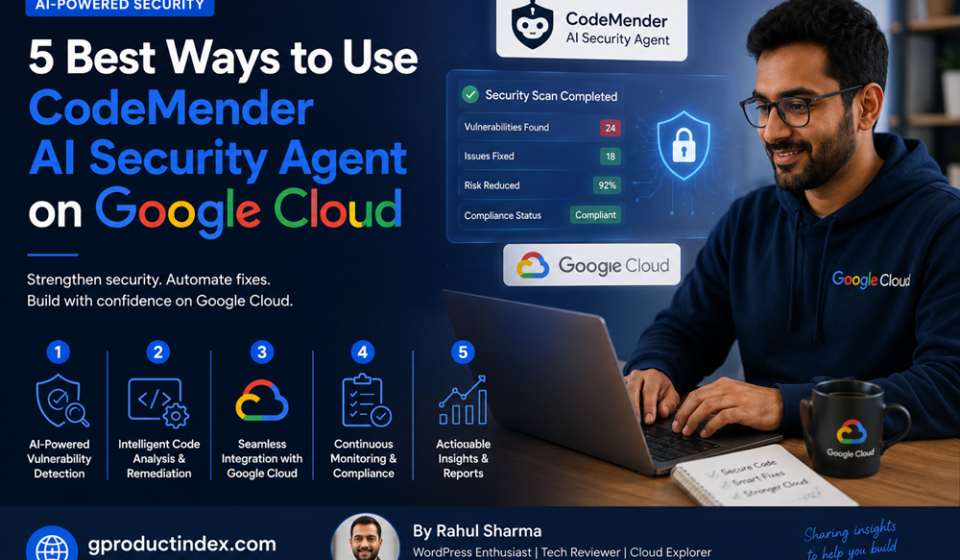

The CodeMender AI security agent is an advanced autonomous code remediation system built by Google DeepMind and natively deployed within Google Cloud’s AI Threat Defense ecosystem. Operating on frontier reasoning infrastructure like Gemini Deep Think, it scans enterprise code repositories to identify structural vulnerabilities, generates targeted source-code patches, and verifies fixes via integrated program-analysis tools. By replacing static security alert logs with automated pull requests under human review, the CodeMender AI security agent enables engineering teams to fix deep bugs and close vulnerability exploitation windows at machine speed.
Introduction
The rise of highly capable reasoning software has altered the timeline of enterprise software defense. Adversaries routinely use automated exploitation scripts to scan target ecosystems, evaluate patch differences, and weaponize software vulnerabilities in minutes. Traditional patch management programs that depend on manual triage and human software engineering are simply too slow to contain threats within this condensed timeline.
To outpace these automated exploits, enterprise tech stacks require an active, secure-by-default architecture. The launching of Google AI Threat Defense marks a major milestone in this transition.
At the center of this protective framework is the CodeMender AI security agent, a dedicated multi-agent system built by Google DeepMind. Instead of burdening development leads with lengthy vulnerability logs, the CodeMender AI security agent directly intervenes in the development chain to discover, validate, and repair complex software security flaws autonomously.
Autonomous Vulnerability Remediation on Google Cloud
Deploying the CodeMender AI security agent within your cloud architecture turns passive vulnerability monitoring into proactive security engineering. Standard application security tools like static analysis software or dynamic testing scanners function mostly as reporting dashboards. They provide developers with dense reports filled with false positives, leaving teams to manually write repairs for deep architectural bugs.
The CodeMender AI security agent fixes this operational bottleneck by working as an automated developer inside your pipeline. It connects directly with infrastructure visibility tools to protect your environment at every level. The CodeMender AI security agent works across your entire continuous integration flow to verify syntax and logic simultaneously.
Live Exposure Mapping and Contextual Prioritization
Modern cloud security requires comprehensive visibility. Through integrations with top cloud protection platforms like Wiz, the overall defense system maps exposed services, APIs, and credentials. When an AI penetration tester detects an exploitable path, it determines whether that risk reaches critical source files. The CodeMender AI security agent relies on this contextual data to prioritize which system bugs need an urgent patch first.
If a vulnerability is verified as reachable, the system hands the context directly to the CodeMender AI security agent to initiate immediate, automated remediation. When the CodeMender AI security agent takes control, it isolates the branch automatically to begin debugging without service downtime.
The CodeMender Multi-Agent Collaboration Loop
The inner workings of the CodeMender AI security agent rely on multiple specialized AI modules working together. Rather than letting one language model write code unchecked, the CodeMender AI security agent divides tasks among distinct sub-agents:
- The Analysis Sub-Agent: Traces execution logs and analyzes raw code semantics to find the root cause of a vulnerability. This sub-agent provides the core structural blueprint that the primary CodeMender AI security agent uses to map code logic.
- The Generation Sub-Agent: Leverages Gemini Deep Think to draft exact code fixes or refactor legacy code blocks into modern structures.
- The Critique Sub-Agent: Evaluates code changes against style rules, checking for accidental regressions or secondary flaws before human engineers see the work.
Two Operational Modes for Long-Term Software Health
The CodeMender AI security agent works across two operational layers to maximize security:
- Reactive Patching: The CodeMender AI security agent intercepts newly announced vulnerabilities, instantly writing and testing fixes to close the window of exploitability.
- Proactive Hardening: The CodeMender AI security agent refactors older, stable application code to remove entire categories of vulnerabilities, such as adding bounds-safety annotations to legacy files.
How CodeMender Patches Software Bugs Autonomously
The core value of the CodeMender AI security agent lies in its rigorous verification process. Writing a patch is only half the battle; ensuring the fix does not disrupt existing business logic requires a comprehensive suite of program-analysis tools. The CodeMender AI security agent ensures that every line of altered code matches strict quality thresholds before human engineers ever receive a notification.
1. Root-Cause Analysis via Deep Reasoning
When an issue is flagged, the CodeMender AI security agent does more than apply superficial pattern fixes. For example, if an application throws a heap buffer overflow error during an XML import process, the CodeMender AI security agent traces the data lifecycle back to the initial parsing library. The CodeMender AI security agent fixes the underlying parsing error at the source rather than just patching symptoms downstream.
2. Multi-Tier Program Validation
Once the generation agent develops a fix, the CodeMender AI security agent subjects the patch to a series of traditional software engineering tests:
- Static Analysis: The CodeMender AI security agent runs strict type-checking and symbolic reasoning tools to evaluate code safety boundaries without executing the file.
- Dynamic Fuzzing: The patch is deployed inside isolated virtual sandboxes, where the CodeMender AI security agent bombards the runtime with randomized data inputs to verify absolute stability.
- Mathematical Solvers: The system applies constraint-satisfaction reasoning via SMT solvers to mathematically prove the safety of the modified code boundaries.
3. Functional Equivalence Verification
To ensure a security fix does not break standard application behavior, the CodeMender AI security agent uses an independent LLM judge to verify functional equivalence. This judge validates that output formats, processing speeds, and core behaviors match the original system design. If any variance is caught, the CodeMender AI security agent initiates a self-correction loop, refining the patch until it passes all functional tests.
4. Human-Supervised Pull Requests
Once a patch clears every verification layer, the CodeMender AI security agent packages the fix into a clean pull request. This request contains the code adjustments, the technical rationale behind the fix, and the complete test results. Human developers maintain final sign-off authority, reviewing and merging the verified code change into production.
Common Software Security Automation Pitfalls to Avoid
Transitioning to an automated remediation model requires clear boundaries and realistic operational strategies. DevSecOps teams should be mindful of common deployment mistakes when managing the CodeMender AI security agent.
Relying on Generic Code Assistants Without Verification Toolchains
Standard code models often produce code that looks correct but fails during execution or contains subtle runtime errors. Running an automated pipeline without strict validation tools like dynamic fuzzing, regression testing, and semantic analysis can introduce new software stability risks. The CodeMender AI security agent eliminates this pitfall by integrating mathematical solvers directly into its core code-writing engine.
Completely Removing Developers from the Review Process
Attempting to deploy automated code fixes directly into live production environments without engineer oversight is risky. Complex business rules often require human context. Keeping experienced developers in the loop ensures all patches written by the CodeMender AI security agent align with broader corporate architectural standards.
Overlooking Code Consistency and Maintenance Standards
Automated patches that ignore local styling, formatting, or design conventions create significant technical debt. If automated modifications appear disjointed from the surrounding codebase, development teams may overwrite or discard them during subsequent code updates. The CodeMender AI security agent resolves this by matching its generated outputs to the specific style guidelines found within your project s repository.
Advanced Strategies for Enterprise DevSecOps Teams
To unlock the full potential of the CodeMender AI security agent, enterprise infrastructure leads should embed its autonomous features deeply into their software delivery loops.
Integrate Patch Workflows with Live Threat Intelligence
Maximize the efficiency of your automated patching loops by connecting repo-level agents directly to global threat indicators, such as Mandiant threat intelligence logs. By pairing the CodeMender AI security agent with real-time exploit tracking, your pipeline can prioritize fixing internet-facing production services before addressing lower-risk internal applications.
Accelerate Memory-Safe Code Migrations
Incorporate automated remediation into your proactive infrastructure refactoring schedules. Instead of using the CodeMender AI security agent only for emergency patches, use it to scan aging applications and convert legacy C or C++ modules into memory-safe structures. This approach eliminates structural risks before vulnerabilities can be discovered by malicious actors.
Enforce Isolated Sandbox Testing for AI Changes
Run all patch verification loops within highly secure, isolated cloud sandboxes. Because the CodeMender AI security agent actively evaluates code changes against edge-case errors and simulated exploit vectors, strict sandbox containment ensures these tests never impact the availability of your live application environments.
Enterprise AI Security Platforms Comparison
The table below details how the CodeMender AI security agent differs from classic testing tools and basic generative coding assistants.
| Capability Feature | Traditional SAST / DAST Tools | Basic GenAI Coding Assistants | CodeMender AI Security Agent |
| Primary Output | Static alert logs and reports | General code snippets | Validated, production-ready pull requests |
| Core Workflow Role | Detection and risk reporting | Manual interactive drafting | Autonomous remediation and testing |
| Verification Tools | Simple syntax rule checks | No built-in verification tools | Fuzzing, SMT solvers, and dynamic checks |
| Contextual Awareness | Limited to single file context | Limited to active editor tab | Full cloud infrastructure and risk mapping |
| Refactoring Engine | None | Fragmented line edits | Deep multi-agent proactive structural rewrites |
Pros and Cons of Autonomous Security Agents
Pros
- Machine-Speed Patching: Minimizes the time between vulnerability discovery and patch deployment, significantly reducing zero-day risks.
- Reduces Technical Debt: The CodeMender AI security agent automates time-consuming triage tasks, allowing software engineering teams to focus on core feature development.
- Rigorous Verification Pipelines: Combines generative model logic with mathematical solvers and fuzz tests to ensure code safety.
- Proactive Structural Hardening: The CodeMender AI security agent eliminates entire categories of software flaws by refactoring fragile legacy architectures in advance.
Cons
- Requires Developer Oversight: Complex business logic requires final human review to ensure long-term architectural alignment with the CodeMender AI security agent.
- Sandbox Infrastructure Demands: Running comprehensive dynamic analysis and fuzzing suites managed by the CodeMender AI security agent requires structured cloud computing resources.
Frequently Asked Questions
What is the CodeMender AI security agent?
The CodeMender AI security agent is an autonomous software security system built by Google DeepMind. It automatically discovers, patches, and validates software bugs and system vulnerabilities.
How does the CodeMender AI security agent operate within GCP?
It integrates into Google AI Threat Defense, combining infrastructure visibility context with automated developer tools to generate and test code patches within secure development pipelines.
Does the CodeMender AI security agent replace human engineers?
No. The CodeMender AI security agent functions as an automated security engineer under human supervision. Developers maintain final oversight and approve all pull requests before deployment.
What program language bases does the agent support?
The system is optimized for common enterprise languages, including C/C++, Go, Java, and Python, with a strong focus on migrating legacy code into memory-safe configurations.
How does CodeMender ensure a patch does not break existing apps?
The CodeMender AI security agent utilizes a specialized multi-agent architecture where an independent LLM judge analyzes functional equivalence before and after code changes to prevent behavioral regressions.
What traditional tools are embedded in the agent’s pipeline?
The pipeline combines advanced language models with traditional program-analysis tools, including static code analyzers, dynamic runtimes, input fuzzing utilities, and symbolic solvers.
What is the difference between reactive and proactive code remediation?
Reactive patching repairs vulnerabilities as soon as they are flagged. Proactive hardening systematically analyzes stable applications to update fragile code blocks before an exploit occurs with the CodeMender AI security agent.
Can the CodeMender AI security agent work across hybrid clouds?
While native to Google Cloud’s AI Threat Defense platform, specialized global integration partners help deploy these autonomous workflows across diverse enterprise hybrid cloud architectures.
How does the tool prevent buggy patches from reaching repositories?
All proposed changes run through a dedicated critique sub-agent and undergo extensive automated testing within isolated sandboxes to verify stability before generating a pull request.
How can enterprise organizations deploy this security agent?
Organizations can access the CodeMender AI security agent through the Google AI Threat Defense platform, supported by launch integration partners like Accenture, Deloitte, and PwC.
Final Verdict
The launching of the CodeMender AI security agent marks a major shift in modern software defense. Moving beyond passive risk tracking to automated, verified code remediation allows organizations to effectively counter AI-driven exploits.
When paired with cloud infrastructure visibility tools, the CodeMender AI security agent provides DevSecOps teams with a scalable, reliable way to eliminate software flaws and secure codebases without increasing developer burnout.
Technical Resources and References
Internal Links
For a deeper dive into our architectural components, view our related breakdowns:
External References
Review official documentation and industry releases directly from primary authorities:
- Google Cloud Platform: https://cloud.google.com/blog/products/identity-security/introducing-google-ai-threat-defense
- Help Net Security Release Coverage: https://www.helpnetsecurity.com/2026/05/27/google-ai-threat-defense-released/
- Independent Ecosystem Analysis: https://www.efficientlyconnected.com/google-ai-threat-defense-autonomous-security-analysis/