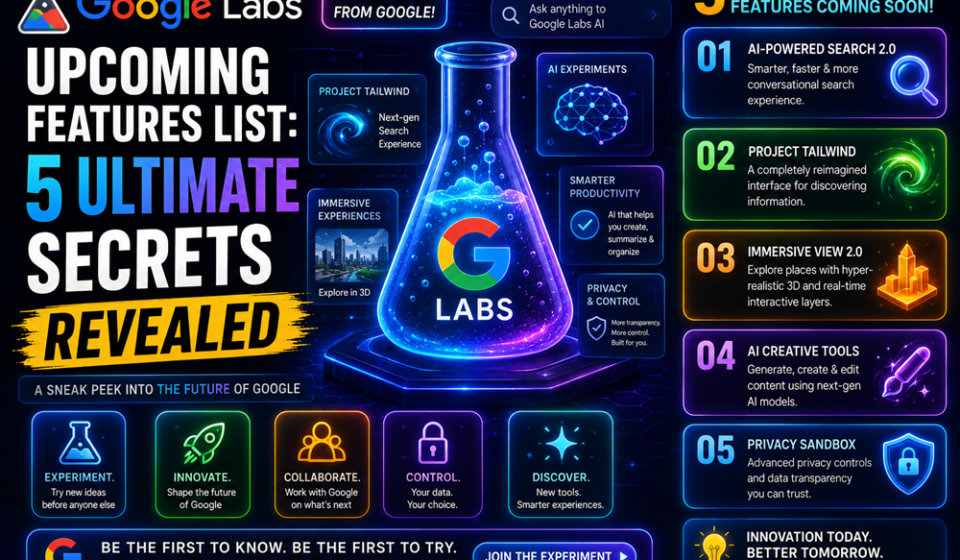

The Google Labs upcoming features list is currently the most explosive roadmap in tech, containing experimental tools that will fundamentally shift how you interact with artificial intelligence. For power users, developers, and digital creators, these hidden prototypes represent the future of automated workflows. Staying ahead of the curve means knowing exactly what is brewing inside Google’s secret AI test kitchen before it hits the mainstream.
The Problem: The Standard AI Fatigue
Most digital professionals feel trapped in a cycle of repetitive prompts and fragmented copy-paste workflows. Traditional generative tools require constant manual intervention, creating a massive productivity bottleneck.
As Google rolls out its latest multimodal models, standard software suites simply cannot keep pace with high-demand production environments. The experimental breakthroughs hidden inside the Google Labs sandbox solve this disconnect by offering autonomous, agentic systems that execute highly complex multi-step workflows.
Deep Technical Analysis: The Agentic Core of 2026
The latest architectural upgrades within Google Labs represent a tectonic shift from traditional text-generation assistants to autonomous execution frameworks. Powering these cutting-edge tools is the next-generation model architecture, designed for extreme context reasoning and multimodal data synthesis.
According to technical specifications published on Google, these upcoming features leverage advanced cross-modal execution loops. Rather than processing text and media as separate streams, these models process video, real-time audio, and browser automation natively within a singular, unified execution layer. This allows experimental platforms to interact directly with live web environments while managing state memory over massive datasets without performance degradation.
Step-by-Step Guide: Accessing and Testing the Secrets
5 Mind-Blowing Features on the Google Labs Roadmap
To maximize your day-to-day workflow efficiency, you must master the core components of the current Google Labs ecosystem. These tools bypass generic text generation, focusing instead on structural layout, programmatic creation, and dynamic automation.
Real Use Cases for Power Users
Software developers use these experimental tools to automate code migrations that previously required weeks of intensive manual oversight. By setting up isolated sandboxes within the latest development hubs, engineers safely rewrite legacy codebases into modern frameworks in hours.
Concurrently, corporate research departments rely on these advanced features to scan hundreds of academic papers simultaneously. The underlying models synthesize vast datasets, instantly generating comprehensive multi-variable data tables, comparative analysis charts, and detailed structural reports.
Expert Tips for Early Access
- Always use a dedicated sandbox account when connecting external file directories to live experimental tools.
- Keep your system prompts hyper-specific by explicitly defining input parameters, constraints, and structural output formats.
- Make use of localized client applications to execute secure scripting sequences without incurring cloud platform latencies.
- Monitor developer communities on GitHub to discover custom configurations for localized API sandboxes.
Common Mistakes to Avoid
Many users treat these experimental systems like basic search engines, inputting brief, single-word commands instead of contextual parameters. This limits the multi-agent execution loops, resulting in generic outputs that completely fail to capture the power of the core system.
Additionally, over-relying on cloud rendering without verifying local security parameters can lead to broken workflows. It is essential to remember that experimental tools can undergo rapid structural adjustments, making regular data backups a critical rule for your daily testing routines.
Pros and Cons of Google’s Experimental Ecosystem
Pros
- Gives you immediate access to frontier-level AI execution frameworks before they go public.
- Drastically minimizes manual data entry through autonomous, multi-step agent behaviors.
- Provides flawless, native integration across complex developer tools and cloud infrastructures.
Cons
- Interface layouts and feature availability can shift rapidly without prior notice.
- Requires higher technical competency compared to standard, consumer-facing commercial applications.
Final Verdict
The Google Labs upcoming features list is a definitive glimpse into a highly integrated, agentic ecosystem. For tech enthusiasts and enterprise power users looking to break past basic AI chat limitations, mastering these tools right now is a vital competitive necessity.
FAQ
How often is the Google Labs upcoming features list updated?
The Google Labs upcoming features list receives continuous weekly updates as developer teams push fresh prototypes, model variations, and experimental user interfaces directly into the testing catalog.
Can I securely connect my personal workspace to the Google Labs upcoming features list?
Yes, you can connect your environment to the Google Labs upcoming features list, provided you carefully manage your access permissions and follow established platform security guidelines.
Do tools on the Google Labs upcoming features list require paid subscriptions?
While many initial prototypes on the Google Labs upcoming features list remain accessible for early testers, advanced agentic features eventually require premium developer workspace tiers.
Explore more guides and updates on : https://gproductindex.com/