
The Structural Integration of Commercial AI
The deployment model for corporate productivity software has officially adapted to the agentic era. Following deep system overhauls, understanding the layout of the Google Workspace Intelligence pricing tiers has become an essential requirement for IT managers and chief financial officers. Rather than offering machine learning features as separate, disconnected third-party application plug-ins, Google has woven its reasoning engines straight into the baseline communication layers of Docs, Sheets, Slides, and Gmail.
By choosing a specific path across the available Google Workspace Intelligence pricing tiers, corporate account managers can instantly deploy features like data synthesis, background workflow scripting, and automated inline draft generation. These utilities operate securely within your isolated organization domain, keeping company records separate from public networks.
Whether you are configuring parameters for a local startup or managing a large multi-national cloud infrastructure, selecting the proper tier is the first step toward reducing operational overhead.
The Problem: The Cost Inefficiencies of Unmanaged Team Seat Licensing
Traditional enterprise software expansions introduce immense budget friction. In the past, companies trying to deploy generative assistant features often fell into a costly tracking trap. IT leads would purchase expensive, un-optimized flat-rate external software licenses for entire departments, only to discover that while a few power users heavily utilized the tools, most employees left their seats completely idle. This mismatch resulted in massive software waste.
Analyzing the current Google Workspace Intelligence pricing tiers directly solves this budget leak. By matching specific feature subsets and security profiles to tailored per-seat add-on structures, the platform prevents you from paying for computing power your teams do not need. You can deploy advanced developer data engines exclusively to your technical engineering pods while keeping casual administrative workers on cost-effective, streamlined assistance paths.
Deep Dive: Feature Distribution Across the Commercial Matrix
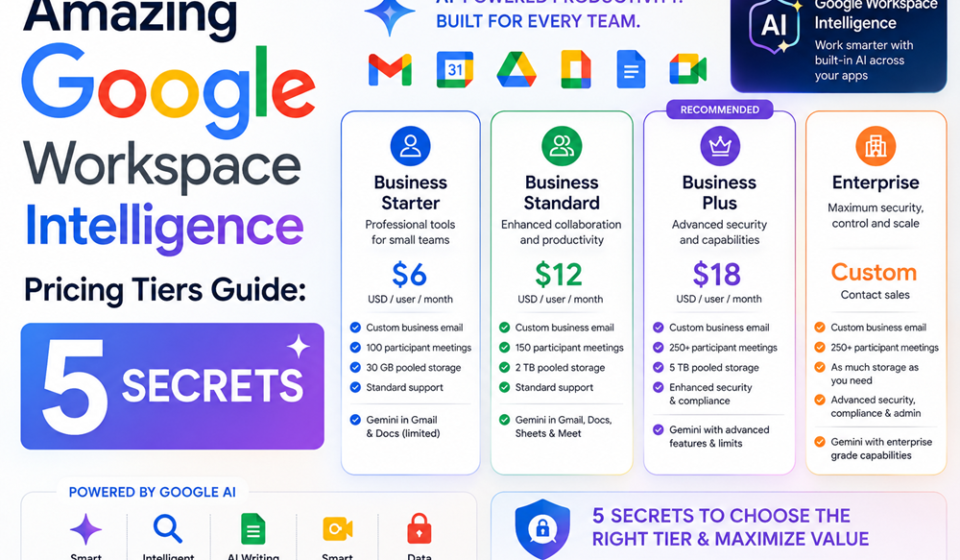
To successfully map out your organizational budget, you must evaluate the strict access boundaries, storage allowances, and administrative security frameworks assigned to each subscription tier. The commercial framework splits its add-on features across these baseline Google Workspace Intelligence pricing tiers:
| Licensing Add-On Tier | Estimated Monthly Cost (Per Seat) | Base Account Requirement | Primary Target & Key Tool Features |
| Gemini Business | ₹1,560 / $20.00 | Business Starter, Standard, or Plus | Aimed at small teams. Includes inline writing assistants, basic Sheets templates, and standard daily data search. |
| Gemini Enterprise | ₹2,340 / $30.00 | Enterprise Standard or Enterprise Plus | Full access for large operations. Includes deep context translation, custom code block scripting, and AI-powered meeting notes. |
| Gemini Education | ₹1,170 / $15.00 | Workspace for Education Fundamentals | Built for academic institutions. Includes student privacy protection filters and automated lesson planning guides. |
By separating core infrastructure parameters like standard text proofreading from enterprise-grade protection frameworks like automated data loss prevention (DLP), the Google Workspace Intelligence pricing tiers matrix ensures compliance with global privacy regulations without inflating your baseline operating costs.
Step-by-Step Guide: Activating an AI Add-On Subscription
Ready to upgrade your company’s administration console, provision your first team seats, and unlock real-time contextual data synthesis across your company threads? Follow this precise sequence to configure your cloud environment safely.
1.Log into the Primary Google Workspace Admin Console:Console Audit.
Open your secure browser window and access your centralized management dashboard. Ensure your administrator profile holds full global privileges before modifying your active service parameters.
2.Navigate to the Apps Billing and Subscriptions Directory:Step 2.
Open the navigation sidebar menu panel. Click straight into the Billing section and select Get More Services to view the available Google Workspace Intelligence pricing tiers options assigned to your region.
3.Select and Initialize Your Target Add-On Tier Profile:Step 3.
Review your options. Select the Gemini Business add-on track to run a quick test group with a small pilot team, or choose the Gemini Enterprise path to deploy advanced security models across the company.
4.Assign Seat Licenses to Specific Organizational Units:Step 4.
Do not apply the upgrade blindly to your entire company domain. Use the organizational unit (OU) menu tree to assign your newly purchased seat credits exclusively to target groups like sales or engineering.
5.Configure Core Security and Enterprise Data Retention Rules:Step 5.
Open your application compliance panel. Turn on strict data isolation policies to guarantee that user-generated internal prompt strings are never saved to public storage systems or used for model training tracks.
Expert Workspace Administration Secrets for Maximum ROI
- Throttle Processing Densities via Organizational Units: Keep a tight grip on software overhead. Build specific rules inside your admin dashboard that restrict high-intensity background automation tools to key departments, keeping your broader user base on streamlined tiers.
- Enforce Strict Customer Data Loss Prevention Rules: Protect your intellectual property from accidental leaks. Set up custom regex filters inside your cloud security compliance panel to instantly block employees from dropping sensitive source code or customer databases into prompt boxes.
- Leverage Native Context Caching Blocks: When multiple employees across your organization reference identical corporate manuals or training handbooks, utilize centralized notebook repositories to keep your shared compute costs as low as possible.
Common Licensing Pitfalls to Avoid
- Purchasing Add-Ons for Incompatible Base Tier Plans: Trying to deploy premium business add-ons onto legacy free accounts or unsupported personal profiles will lock your workflow. Verify your base plan requirements before buying seats.
- Leaving Auto-Renew Active on Seasonal Worker Accounts: If you scale up your workforce during peak seasons with temporary contract staff, remember to manually unassign and de-provision those seat licenses when their projects wrap up to avoid rolling monthly charges.
- Allowing Free-Form Un-audited Prompts in Customer Support: Deploying client-facing automation tools without setting strict input boundaries can expose your platform to injection risks. Always enforce server-side templates to keep your data interfaces completely locked down.
Pros and Cons of the Integrated Intelligence Runtimes
Pros
- Superb Production Acceleration: Eliminates hours of manual data entry by enabling background models to clean spreadsheets and draft correspondence natively.
- Enterprise-Grade Data Security: Protects your proprietary insights by ensuring internal prompts are completely isolated from public training cycles.
- Frictionless Cross-App Continuity: Bridges information across Gmail, Calendar, Drive, and Docs without requiring brittle external API extensions.
Cons
- Significant Per-Seat Cost Overhead: Adding flat monthly fees on top of your baseline service plan can scale up your operational expenses rapidly if seat distributions are unmanaged.
- Strict Minimum Base Commitment Rules: Accessing advanced enterprise tier discounts often requires minimum contract lengths or volume commitments from corporate purchasing departments.
Strategic Real-World Enterprise Use Cases
- Automated Multi-National Campaign Localization: International marketing squads use the platform to take base product sheets, letting the background engine instantly translate layout files, adapt taglines, and draft localized email updates for regional branches.
- Rapid Financial Spreadsheet Data Structuring: Financial analytics groups drop unorganized monthly transaction logs into Sheets, commanding the system to build structured tables, highlight over-billing errors, and generate executive summaries automatically.
- Frictionless Corporate Onboarding Operations: HR departments deploy automated notebook repositories containing company handbooks, allowing new hires to run natural language questions to find internal policies without drawing on manual support lines.
Licensing Optimization Summary & Tactical Next Steps
Analyzing the corporate strategies behind the current Google Workspace Intelligence pricing tiers reveals a clear roadmap toward scaling secure, high-efficiency business automation. By matching your actual user profiles to matching add-on tracks, rolling out seats via targeted organizational units, and setting strict data loss prevention rules, you build an incredibly resilient corporate workspace. Start your optimization journey today by auditing your current team usage, spinning up a limited business pilot ring, and monitoring your productivity metrics to scale your investments safely.
Explore More Google Products & Tools
To see how these new high-speed models fit into Google’s broader software roadmap, check out our comprehensive Google Product Index Categories Hub on the homepage to browse through active enterprise toolsets.
Google Product Index Categories Hub:
https://www.google.com/search?q=https://gproductindex.com/
To track how these new tools fit into the wider landscape of active and legacy applications, you can explore our comprehensive Google Products Database Hub right on our homepage.
Google Products Database Hub:
10. FAQ Schema
What are the main differences among the Google Workspace Intelligence pricing tiers?
The lineup primarily splits into the Gemini Business, Gemini Enterprise, and Gemini Education add-on tracks. The Business plan brings core writing and organization assistants to smaller teams, the Enterprise tier introduces advanced code scripting and robust data loss prevention for large firms, and the Education tier offers secure, low-cost options optimized for schools.
Are my company’s private emails used to train public AI models?
No. Google maintains strict enterprise data privacy boundaries across all active Google Workspace Intelligence pricing tiers. Your organizational data, internal prompt inputs, and email logs remain completely siloed within your secure domain, ensuring your proprietary secrets are never shared or used for public training sets.