
The Shift to Production-Grade Agentic Architectures
The blueprint for enterprise cloud computing has officially entered an autonomous era. As detailed extensively across the Google Cloud Next 2026 recap, the search giant is no longer marketing artificial intelligence as a passive, conversational novelty. Instead, Google has permanently pivoted its cloud computing matrix to support the “Agentic Enterprise”—transforming stateless, isolated models into continuous digital workers that execute long-horizon backend operations entirely on their own.
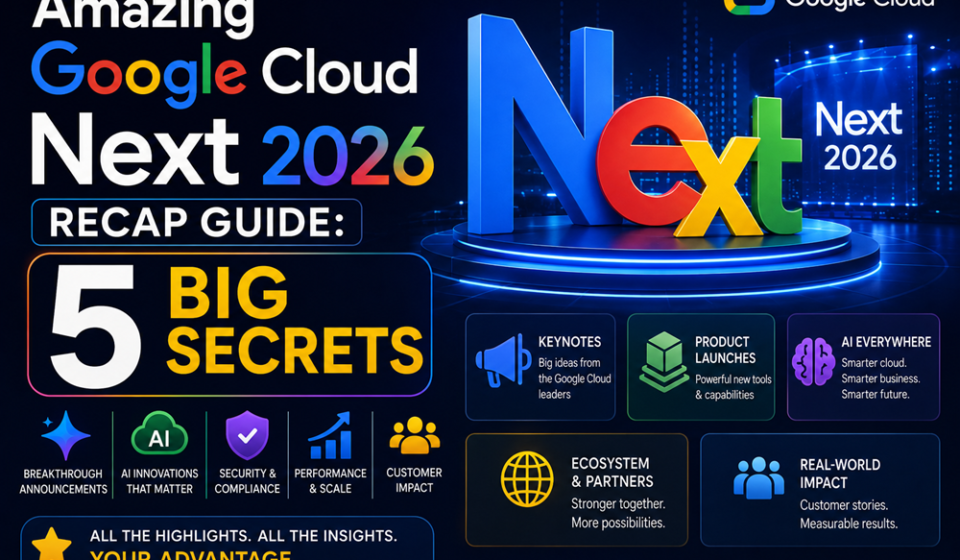
[Image showcasing the 2026 Google Cloud stack blueprint, highlighting the transformation of Vertex AI into the Gemini Enterprise Agent Platform]
By reviewing the infrastructure upgrades outlined in the Google Cloud Next 2026 recap, systems engineers can immediately map out a shift toward highly governed, multi-agent frameworks. This evolution replaces raw API calling routines with structural workflow systems that possess persistent memory profiles, cryptographic agent identities, and sandboxed computer-use execution runtimes.
Whether you are an enterprise system administrator managing massive multi-cloud data layers or an engineer looking to automate repository testing, adapting to these latest updates is critical to maintaining a modern, resilient tech stack.
The Problem: Shifting AI from Stateful Experiments to Scalable Systems
Traditional enterprise AI deployments are hitting a terminal wall. In the past, companies trying to deploy large language models ran into severe operational roadblocks. Most systems functioned as simple, stateless chat applications that lacked any true contextual grounding in actual business operations, forcing developers to build complex, fragile custom data pipelines just to let the AI check real-time company records or execute automated actions safely.
The major software releases highlighted in the Google Cloud Next 2026 recap directly solve this deployment friction. By building autonomous execution guards, centralized tool registries, and semantic context engines natively into the cloud architecture, Google removes the burden of custom pipeline engineering. AI models can now operate continuously in the background, executing complex multi-step tasks without exposing parent infrastructure nodes to security vulnerabilities.
Deep Dive: The Core Systems Architectural Breakdown
To successfully guide a distributed cluster under the updated paradigm, infrastructure leads must understand the specific platform tier overhauls. The technical announcements reveal structural upgrades spanning processing chips, software control planes, and cross-cloud database architectures.
| Architectural Layer | Re-Engineered Component | Core Operational Overhaul |
| Control Plane | Gemini Enterprise Agent Platform | Replaces legacy Vertex AI frameworks, functioning as a full-stack mission control to scale and govern agents. |
| Data Engine | Agentic Data Cloud | Introduces a cross-cloud, zero-copy Apache Iceberg lakehouse with a semantic Knowledge Catalog. |
| Silicon Core | Eighth-Generation TPU v8 | Split into the Torus-backed TPU 8t for dense training and the Boardfly-backed TPU 8i for fast inference. |
By separating core compute needs into specialized training and reasoning hardware, the system maximizes goodput efficiency. According to data tracked during the summit, these underlying structural realignments dramatically decrease tail latency across complex, multi-agent clusters.
Step-by-Step Guide: Aligning with the 2026 Cloud AI Framework
Ready to integrate your cross-cloud databases, configure automated task forces, and deploy your first secure development sandbox runtime? Follow this precise configuration sequence to align your active pipelines with the updated ecosystem standards.
1.Access the New Gemini Enterprise Agent Platform Hub:Console Transition.
Log into your administrative cloud panel. Open your primary orchestration dashboard to review the reconfigured Vertex AI console, which has transitioned fully into the centralized Agent Platform workspace.
2.Initialize the Cross-Cloud Iceberg Lakehouse Engine:Step 2.
Navigate straight to your data operations panel to activate the Agentic Data Cloud layer. Configure your storage buckets to leverage zero-copy federation across external cloud spaces without manual migration.
3.Map Enterprise Business Logic via Knowledge Catalog:Step 3.
Open the upgraded Dataplex panel, now rebranded as the Knowledge Catalog. Establish your team’s semantic definitions and context files to properly ground your background workers and prevent model hallucinations.
4.Configure Secure Sandbox Computer-Use Run Loops:Step 4.
Open your security controls to activate the hardened Agent Sandbox environment. Define explicit firewall parameters and egress constraints to allow agents to safely run browser-based automations.
5.Deploy Cryptographic Agent Identities and Gateway Audits:Step 5.
Go to your identity management desk to assign unique cryptographic signatures to your active workers. Link these definitions directly to the Agent Gateway to enforce consistent Model Armor protection tracking loops.
Expert Systems Architecture Secrets for Agent Optimization
- Leverage the Boardfly Layout on TPU 8i Nodes: When routing real-time multi-agent token decoding tasks, don’t stall your network layers with circular torus pipelines. Run inference workloads on inference-optimized TPU 8i clusters to minimize tail latency.
- Ground Agents Natively via the Knowledge Catalog: Avoid dumping massive, raw text documentation sheets directly into your active conversation prompts. Index your company data paths inside the semantic context engine to optimize token consumption.
- Enforce Strict Agent Evaluation Autoraters: Build continuous testing blocks inside your workspace by using the turn-key Agent Evaluation dashboard, letting multi-turn autoraters continuously score the reasoning paths of your live agent traffic.
Common Enterprise Deployment Pitfalls to Avoid
- Hardcoding Proprietary Authentication Keys inside Agent Code: Storing un-encrypted API secrets within custom prompt files exposes your enterprise network to risk. Always route credentials securely using cryptographic identities managed by the platform.
- Forgetting to Update Deprecated Vertex Command Binaries: If you maintain legacy continuous integration setups tied to historical server commands, update your backend scripts to avoid deployment pipeline errors.
- Allowing Free-Form Outbound Network Egress inside Runtimes: Launching autonomous workers without clamping their digital boundaries invites data extraction vulnerabilities. Force agents to operate inside the secure Agent Sandbox behind strict egress allowlists.
Pros and Cons of the Overhauled Cloud Ecosystem
Pros
- Superb Platform Consolidation: Eliminates brittle, home-grown middleware scripts by providing a native, unified control center for agent governance and observability.
- Outstanding Price-Performance Infrastructure: The specialized dual-chip approach of the TPU v8 family drops processing overhead significantly while maintaining massive compute scales.
- Pragmatic Zero-Copy Data Federation: The deployment of the cross-cloud lakehouse framework allows enterprise teams to index files across AWS and Azure without vendor lock-in.
Cons
- Heavy Rebranding Migration Adjustments: The total platform transition from classic machine learning APIs into agentic workspaces requires teams to reconfigure existing continuous delivery models.
- Compute Consumption Overhead Scrutiny: Running continuous, persistent multi-agent loops across production systems demands strict, proactive quota management to keep monthly cloud billing loops within target metrics.
Strategic Real-World Enterprise Use Cases
- Autonomous Full-System Vulnerability Remediations: Large financial institutions combine the Agent Sandbox alongside local codebase indexing files, allowing background agents to autonomously write, compile, and verify security patches.
- Real-Time Cross-Cloud Logistics Coordination: Global manufacturing enterprises drop fragmented supply data matrices across Azure and Google Cloud databases, utilizing the Agentic Data Cloud to synthesize shipping schedules and resolve inventory updates instantly.
- Hyper-Personalized Commercial Desk Operations: Digital customer support environments deploy automated workers with persistent memory profiles, allowing systems to recall historical user decisions across sessions without manual tracking.
Infrastructure Summary & Tactical Takeaways
Analyzing the core announcements inside the Google Cloud Next 2026 recap highlights a definitive technical evolution toward fully operational, production-grade autonomous infrastructure. By standardizing your worker teams on the Gemini Enterprise Agent Platform, grounding model reasoning via the semantic Knowledge Catalog, and running compute pipelines on specialized TPU v8 silicon arrays, engineers gain an incredibly stable automation framework. Start your migration journey today by auditing your active data readiness, configuring an isolated sandbox testing ring, and tracking performance metrics to scale your cloud operations securely.
Explore More Google Products & Tools
To see how these new high-speed models fit into Google’s broader software roadmap, check out our comprehensive Google Product Index Categories Hub on the homepage to browse through active enterprise toolsets.
Google Product Index Categories Hub:
https://www.google.com/search?q=https://gproductindex.com/
To track how these new tools fit into the wider landscape of active and legacy applications, you can explore our comprehensive Google Products Database Hub right on our homepage.
Google Products Database Hub:
10. FAQ Schema
What is the most significant platform rebranding mentioned in the Google Cloud Next 2026 recap?
The absolute standout software adjustment is the complete transformation of the legacy Vertex AI suite into the Gemini Enterprise Agent Platform. This update transitions the console from a basic model repository into a comprehensive, unified mission control built explicitly to build, scale, govern, and observe autonomous agents at scale.
How does the eighth-generation TPU dual-chip design optimize processing costs?
Google has broken past traditional hardware boundaries by bifurcating its silicon architecture. The TPU 8t is built with a 3D Torus layout optimized to scale up heavy model pre-training jobs, while the TPU 8i utilizes a Boardfly topology and tripled on-chip SRAM to handle low-latency inference and multi-agent token decoding cost-effectively.
What problem does the newly launched Agentic Data Cloud lakehouse solve?
The framework introduces a zero-copy, cross-cloud lakehouse architecture that supports native Apache Iceberg table formats. This eliminates the expensive and complex need to manually move massive datasets between AWS, Azure, and Google Cloud, allowing persistent agents to securely access multi-cloud enterprise logs instantly.