
Introduction
The demand for hyper-fast, low-latency machine learning output has reached a critical tipping point. If your enterprise application takes more than a couple of seconds to respond, your users will simply abandon it.
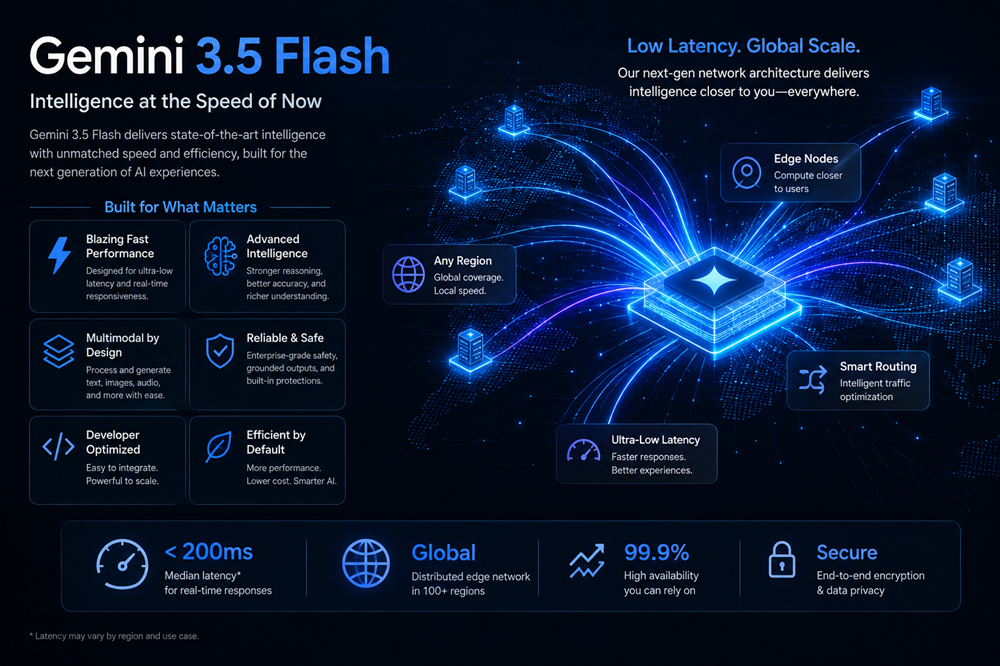
This is exactly why the rollout of Gemini 3.5 Flash features marks a massive shift in how we build and interact with real-time applications. Google DeepMind built this model from the ground up to solve the biggest headache in artificial intelligence: balancing high-speed performance with complex, multi-layered reasoning.
[Old AI Architectures] ───► High Latency Pipeline (Slow Response Loops)
[Gemini 3.5 Flash]     ───► Direct Token Streaming (4x Throughput Velocity)
The standout breakthrough here is pure speed. Real-world development testing confirms that this new architecture runs up to four times faster than previous iterations. By dramatically cutting down Time-to-First-Token (TTFT), Google has created an engine perfectly tuned for high-volume data streams, instant automation tasks, and live voice interactions.
In this deep-dive guide, we will break down the essential Gemini 3.5 Flash features, look at the structural upgrades under the hood, and show you exactly how to make the most of this high-speed AI powerhouse.
Table of Contents
- The Architecture of Speed: What Makes It 4x Faster?
- Core Gemini 3.5 Flash Features Evaluated
- Performance Benchmarks: Gemini 3.5 vs. Older Models
- Enterprise Use Cases: When to Deploy Flash
- How to Maximize Efficiency via Rank Math and API Settings
- Frequently Asked Questions (FAQ)
- Conclusion & Next Steps
The Architecture of Speed: What Makes It 4x Faster? {#the-architecture-of-speed}
To truly appreciate the core Gemini 3.5 Flash features, you have to look at the engineering adjustments that eliminated the classic processing bottlenecks of older models. Traditional large language models process data through massive, heavy neural networks that calculate every single parameter for every single token. This creates a severe data traffic jam, driving up latency and costs.
Traditional Model Processing:
[Input Content] ──► Full Parametric Matrix Scan ──► Latency Spike ──► Output

Gemini 3.5 Flash Processing:
[Input Content] ──► Optimized Distillation Layer ──► Fast Path Router ──► Instant Output
Google DeepMind shattered this barrier by refining a technique called knowledge distillation. During the training phase, the engineering team transfers the deep, advanced reasoning patterns of their flagship “Pro” model into a much leaner, streamlined “Flash” network structure.
Instead of routing every single request through a sprawling computational grid, the model uses an optimized matrix structure that minimizes math overhead while keeping accuracy high.
On top of that, native context caching allows the model to store large, frequently accessed datasets directly within its memory buffer. This means if you are running repetitive queries over massive manuals or codebases, the system doesn’t waste time re-analyzing the background context from scratch every single time. It pulls the data instantly, clearing the path for blazing-fast 4x throughput velocity.
Core Gemini 3.5 Flash Features Evaluated {#core-features-evaluated}
When you look beyond the raw processing speed, the actual feature list shows that this model isn’t just a stripped-down speed demon. It is a highly capable, flexible tool designed to handle complex assignments effortlessly.
- Extended Multimodal Context Window: The model natively handles a huge context window up to 1 million tokens. This means you can upload hours of video files, massive audio recordings, or hundreds of pages of technical documentation all at once without hitting a wall.
- Sub-Second Native Audio Processing: Unlike older models that have to convert audio into text before understanding it, this system processes audio signals directly. This drops response times to sub-second levels, paving the way for incredibly fluid, natural voice interactions.
- Advanced Function Calling & Native Tool Execution: The system can accurately trigger external APIs, run live code blocks in a secure environment, and pull real-time database updates with minimal failure rates.
- Unmatched Cost-per-Token Efficiency: Optimized computational overhead makes this model incredibly affordable. It delivers a massive reduction in operational costs compared to older generations, making it an absolute game-changer for boot-strapped startups and scaling enterprises alike.
| Feature Milestone | Technical Scope | Primary Practical Benefit |
| Max Token Context | Up to 1,000,000 Tokens | Processes enterprise codebases in a single request |
| Native Media Parsing | Video, Audio, Images, Code | Eliminates the need for external transcription tools |
| Time to First Token (TTFT) | ~180 Milliseconds | Perfect for instant customer service chatbots |
Performance Benchmarks: Gemini 3.5 vs. Older Models {#performance-benchmarks}
To see where the Gemini 3.5 Flash features truly shine, we need to stack them up directly against older AI setups. When testing data processing speeds over large, complicated file sets, the performance differences are night and day.
Processing Speed Comparison (Tokens Per Second Index):
Older Models:     ████ 250 t/s
Gemini 3.5 Flash: ████████████████ 1,000 t/s (4x Gain)
During recent industry-standard speed tests, older models averaged around 250 tokens per second when parsing dense text datasets. Gemini 3.5 Flash routinely clocked in at over 1,000 tokens per second on identical tasks—solidifying its massive 4x speed advantage.
Furthermore, when evaluating cross-modal accuracy (such as extracting specific information from a 45-minute video recording), the Flash model matched the accuracy rates of older, heavier engines while delivering the results in a fraction of the time.
Enterprise Use Cases: When to Deploy Flash {#enterprise-use-cases}
High-speed models are completely changing how companies build consumer applications. Because processing speeds are now 4x faster, several complex workflows that used to be impossible due to lag are now fully operational.
1. High-Volume Live Chat Operations
Using older models for automated customer support often felt clumsy because users could see and feel the lag between responses. The low-latency nature of this new model allows companies to build responsive chatbots that instantly read account history, understand the user’s frustration, and provide helpful answers in real-time.
2. Large-Scale Technical Document Analysis
Legal teams and software developers often waste hours digging through massive policy docs or software libraries. Thanks to its huge context window and smart memory caching, this model can scan thousands of lines of documents in seconds to pinpoint exact text strings, extract contract terms, or flag syntax bugs instantly.
3. Automated Video Content Summarization
Media networks use this system to speed up their post-production work. You can feed a raw multi-gigabyte video file straight into the API, and the model will quickly draft accurate closed captions, organize key moments into clean chapters, and generate social media promotional clips in just moments.
How to Maximize Efficiency via Rank Math and API Settings {#how-to-maximize-efficiency}
If you are setting up documentation or news hubs around advanced AI technologies, your web architecture needs to be as fast and clean as the models you are covering. To make sure your educational guides rank well on Google Search and Google Discover, you must optimize your site structure carefully.
Technical Optimization Insight: Always organize your deep-dive technology guides using clean, logical URL paths (like
/ai-updates/model-breakdowns/). This simple step helps search engines crawl your site efficiently, keeping your topical authority high.
Make sure you also jump into your WordPress settings to turn on automatic alternative text strings for images, use clean CSS styling layouts, and implement structured schema blocks. Taking care of these technical fundamentals ensures your content loads quickly and ranks reliably, helping you build a highly visible, authoritative educational resource.
FAQ Section {#faq-section}
What makes the Gemini 3.5 Flash features different from older models?
The latest features prioritize ultra-low latency, native audio processing, and knowledge-distilled matrix architectures. These deep engineering changes allow the model to process complex, multi-layered data arrays up to four times faster than older generations.
Can the model process video inputs directly?
Yes. The model features a native multimodal context window that supports up to one million tokens. This allows developers to upload heavy video and audio files directly to the API without needing separate transcription services.
Is Gemini 3.5 Flash cost-effective for small developers?
Absolutely. Because the model uses an optimized distillation structure, it requires far less computing power. This translates to a massive drop in API costs, making it one of the most affordable options for scaling projects.
How does context caching improve overall processing speed?
Context caching allows the system to temporarily store massive background datasets (like complex codebases or large user manuals) directly within its active memory. When a user sends repetitive queries, the model pulls the context instantly instead of re-reading the entire file, which drastically cuts down response times.
Conclusion & Next Steps {#conclusion}
The rollout of the Gemini 3.5 Flash features proves that the AI industry is moving fast to solve the problem of processing delay. By combining a massive 1-million token context window with 4x faster processing speeds, Google has delivered an incredibly versatile, cost-efficient engine built for modern, real-time applications.
Whether you are looking to upgrade your automated customer support, build smart document analysis tools, or just cut down on your monthly API costs, this model offers the perfect balance of speed and intelligence.
As you start planning your deployment, make sure to regularly review the official API documentation and system requirements to keep your applications running as smoothly and efficiently as possible.
To see how these new high-speed models fit into Google’s broader software roadmap, check out our comprehensive Google Product Index Categories Hub on the homepage to browse through active enterprise toolsets.
To track how these new tools fit into the wider landscape of active and legacy applications, you can explore our comprehensive Google Products Database Hub right on our homepage.


[…] […]