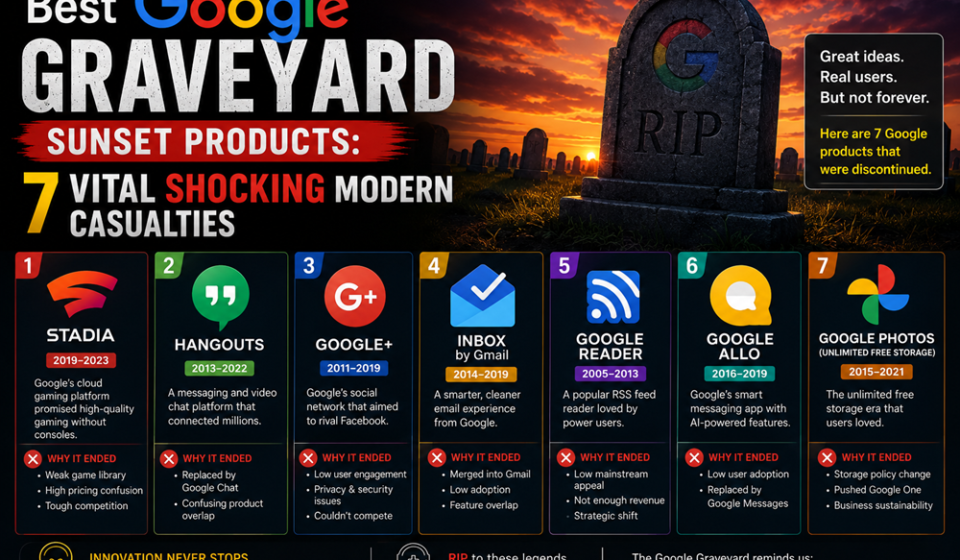

For seasoned technology administrators and everyday software users alike, building your daily digital workflows on top of Alphabet Inc. services has started to feel like a high-stakes game of roulette. There is a widening systemic challenge building across the technology sector: a wave of trust decay. Users are increasingly frustrated by corporate patterns where stable tools are abruptly renamed, rate-limited, or completely sent to the infamous Google Graveyard sunset products list before long-term dependency can even mature.
The internal pruning strategy inside Google moves exceptionally fast. While the company uses events like Google I/O 2026 to showcase cutting-edge breakthroughs, its internal teams are quietly pulling the plug on dozens of legacy applications, beta experiments, and core system utilities.
Whether you are trying to recover stranded cloud data or looking to replace an infrastructure tool that suddenly stopped working, this definitive post-mortem reports on the most significant modern entries in the archive of Google Graveyard sunset products.
Why Does the Google Graveyard Keep Expanding?
Before examining individual entries, we must look at the structural mechanics of how products end up on the Google Graveyard sunset products list. Google relies on a Minimum Viable Product (MVP) model: launching experimental features quickly, tracking usage data over a short window, and rapidly reallocating server computing power to higher-priority infrastructure if growth targets stall.
Product Life Expectancy Benchmarks
An analysis of recent corporate data shows that software lifespans vary drastically depending on user engagement metrics and internal infrastructure costs:
| Discontinued Platform | Primary Service Type | Lifespan Duration | Primary Cause of Sunset |
| VPN by Google One | Consumer Security | 3.5 Years | Low user utilization rates |
| Google Domains | Network Infrastructure | 9 Years | Portfolio asset sale to Squarespace |
| Project Mariner | Experimental AI Agent | 6 Months | Integrated into core Gemini models |
| Tenor API | Media Database Access | 11 Years | Deprecation of developer pathways |
7 Major Software & Platform Casualties
1. VPN by Google One (Consumer Security)
One of the most unexpected consumer shutdowns was the official termination of VPN by Google One. Originally bundled as a premium privacy benefit for Google One cloud storage subscribers, the service provided quick IP-masking tools across mobile platforms. Google officially retired the utility after internal audits revealed that the vast majority of users simply weren’t utilizing the feature, allowing the company to refocus its security resources elsewhere.
2. Google Domains (Infrastructure Access)
For almost a decade, Google Domains was a highly popular domain name registrar praised for its clean interface, simple DNS configuration, and free privacy protection features. In a surprise corporate shift, Google completely ended its domain services and sold its entire registration portfolio directly to Squarespace, forcing millions of active domains into an external migration process.
3. Project Mariner (Agentic AI Framework)
Even advanced artificial intelligence projects aren’t safe from sudden changes. Project Mariner was an experimental AI framework designed to run autonomous agents directly across desktop browsers to automate web workflows. Google abruptly shut down Mariner as a standalone initiative, choosing instead to merge its browser-control capabilities directly into the core Gemini 3.5 engine.
[Standalone Beta App] ➔ [Low Independent Engagement] ➔ [Feature Stripped] ➔ [Merged Into Core Gemini App]
4. Tenor API (Developer Media Delivery)
A fundamental piece of internet culture communication is getting scaled back. The Tenor API, which for over eleven years powered GIF search integrations across massive external messaging platforms like Discord, is officially being phased out. Developers are being forced to transition away from these legacy connection paths as Google closes old media routing layers.
5. Firebase Studio (Cloud Development Environment)
Even toolsets built for software engineers are regularly sent to the Google Graveyard sunset products roster. Firebase Studio, an agentic, cloud-based browser interface that allowed developers to build and preview application builds natively, has been given an explicit end-of-life timeline less than three years after its launch.
6. Steam for Chromebooks (Beta Gaming Initiative)
Launched to bring high-end PC gaming to light computing hardware, the Steam for Chromebooks beta program has been formally shuttered. The project spent nearly three years in an unpolished state before Google ended development, advising users to look toward cloud-based alternatives instead.
7. Tables by Area 120 (Automation Database)
Born out of Google’s internal startup incubator, Tables by Area 120 was a structured, collaborative tracking database designed to compete directly with platforms like Airtable. Despite building a dedicated user base through its useful automation rules, the standalone platform was officially sunsetted as part of broader cloud cost consolidations.
Critical Action Steps: How to Recover Your Stranded Data
If you are currently running a personal project or business workflow on any component listed as a Google Graveyard sunset products entry, follow this immediate recovery checklist:
- Locate the Migration Window: Check the official deprecation alerts for your specific tool to find the final data checkout deadline.
- Request a Takeout File: Navigate directly to Google Takeout, check the boxes for your affected services, and download your complete JSON or CSV data archives.
- Update Your App Integrations: For developer tools like the Tenor API or Firebase Studio, update your dependencies to prevent broken features or system crashes.
- Verify Domain Records: If your domain was moved from Google Domains to Squarespace, log into your new dashboard to confirm that your custom DNS records and nameservers are routing correctly.
- Audit Third-Party Storage Accounts: Review any automated backup loops connected to sunset services to ensure your off-site files remain accessible.
Summary of Platform Transitions
Navigating the changing landscape of Google Graveyard sunset products requires regular maintenance of your personal and professional digital setups. To learn more about how these infrastructure choices affect your workflow, check out the core directory guidelines right on our Homepage Matrix Index. By staying informed on upcoming feature shutdowns and keeping clean local backups of your data, you can build resilient workflows that weather sudden changes in the software industry.
5. FAQ Section
What exactly are Google Graveyard sunset products?
This phrase refers to the collective group of standalone applications, hardware models, and developer services that Google has officially discontinued, sunsetted, or retired over its corporate history.
Where can I find a complete list of killed Google apps?
We maintain a live, chronological list tracking every single discontinued tool. You can explore the full timeline directly on our Google Graveyard Registry Archive.
Why does Google frequently shut down popular services?
Google generally sunsets products due to low long-term user engagement, high server maintenance costs, shifting corporate directions, or to consolidate separate features directly into primary platforms like Google Workspace or Gemini.
What happened to my domains after Google Domains shut down?
All active domain registrations, billing structures, and custom DNS records were automatically packaged and migrated over to Squarespace under an asset sale agreement.
6. External Authority Suggestions
- Reference Placement 1: Add a link to the Official Killed by Google Open-Source Database next to the product lifespan breakdown table.
- Reference Placement 2: Link to the Chrome Enterprise End of Support Policy near the platform migration steps.
To track how these new tools fit into the wider landscape of active and legacy applications, you can explore our comprehensive Google Products Database Hub right on our homepage.