
Amazing Google I/O 2026 Announcements Matrix: 7 Great Reveals
The global tech landscape just experienced a profound structural realignment. The official Google I/O 2026 announcements reveal that the search giant is no longer building basic passive chat applications. Instead, Google has deployed an interconnected blueprint for an “Agentic Web”—weaving artificial intelligence directly into the background fabric of cloud platforms, mobile operating systems, browser engines, and wearables.
Whether you are a developer looking to deploy persistent background scripts or a business leader optimizing your product pipeline, staying ahead means mastering this massive wave of new releases.
This master-level breakdown acts as your operational matrix, mapping out everything unveiled at the latest keynote from frontier models to hardware ecosystems.
The Problem: Siloed Chatbots vs. Continuous Workflow Demands
Until now, the AI boom felt heavily fragmented. Users had to juggle standalone apps for content writing, specialized search tasks, background monitoring, and code debugging. This separation created massive friction, requiring tedious copy-pasting across browser windows and brittle API integrations to achieve basic tasks.
The latest Google I/O 2026 announcements solve this operational fragmentation. By embedding autonomous capabilities into core consumer platforms, Google is fundamentally shifting the paradigm from on-demand prompting to persistent, ambient automation. Niche standalone services face an extinction event as native, background-driven digital ecosystems become standard across billions of active accounts.
Deep Dive: The Core Google I/O 2026 Announcements Architecture Matrix
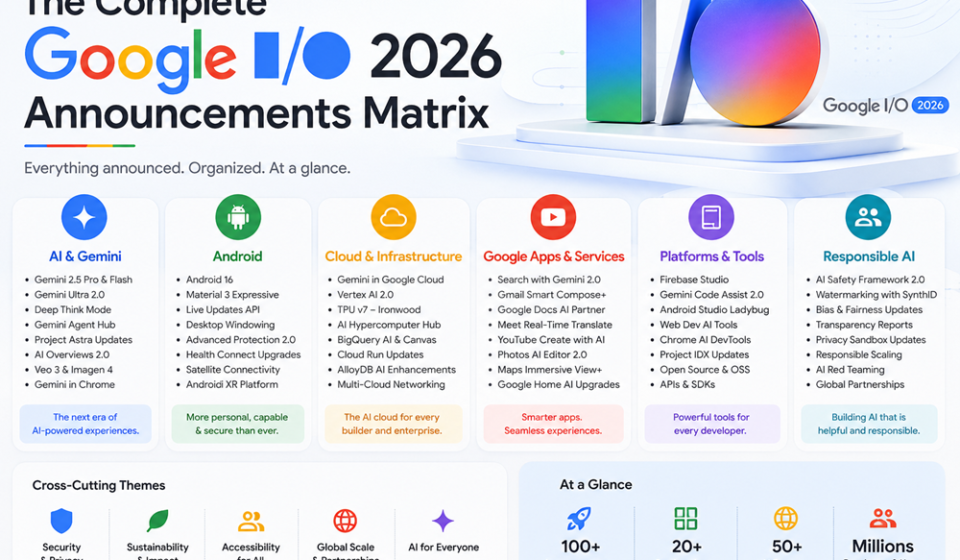
To understand the scope of this transformation, we can organize the foundational software releases, development tools, and consumer application overhauls into a clear, unified layer architecture.
| Ecosystem Layer | Highlighted Release | Primary Operational Purpose |
| Frontier Engine | Gemini 3.5 Flash | High-speed processing core serving as the default logic engine across consumer apps. |
| Media Generation | Gemini Omni & Flow | Multimodal synthesis creating high-fidelity video, audio, and music from unified prompts. |
| Ambient Automation | Gemini Spark | 24/7 autonomous worker handling background file modifications and third-party tools. |
| Developer Framework | Google Antigravity 2.0 | Desktop app, SDK, and CLI environment built for orchestrating autonomous agents. |
| Spatial Hardware | Android XR Glasses | Audio and voice smart glasses with visual context tracking powered by Gemini. |
By upgrading the foundational architecture to Gemini 3.5 Flash right out of the gate, processing workflows achieve unprecedented speed, blasting through long-horizon developer tasks and continuous consumer processes without latency spikes. This fundamental baseline shift is one of the most celebrated elements across the entire catalog of Google I/O 2026 announcements.
Step-by-Step Guide: How to Align with the New AI Stack
Navigating the updated ecosystem requires adjusting your workflows. Use this procedural method to seamlessly transition your technical pipelines to the new standards.
1.Provision the $100 Google AI Ultra Plan:Environment Check.
Log into your administrator account and transition to the updated subscription plan. This upgrades your environment capacity, granting priority access to the Antigravity agent harness and five times the computing throughput.
2.Deploy the Antigravity 2.0 Desktop Surface:Step 2.
Download the standalone independent agent application or initialize the Antigravity CLI within your local workstation terminal to connect directly to the underlying model architecture.
3.Initialize Background Crons in Gemini Spark:Step 3.
Access the Spark configurations console inside Workspace. Set up your automated cron rules to continuously index specific incoming file arrays, build data spreadsheets, or track web pricing variables.
4.Activate Chrome Skills Framework:Step 4.
Open your desktop web browser and navigate to the Skills panel. Convert your most frequent multi-tab validation procedures, product feature matrices, or long-form research scripts into single-click automation tools.
5.Integrate Universal Shopping and Agent Payment Protocols:Step 5.
Link your banking parameters to the secure Agent Payments Protocol (AP2). This enables your active background search agents to securely check out items across multiple storefronts with predefined spending limits.
Expert Operational Tips for Dominating the Agentic Era
- Rethink Web Search Intent Strategy: Traditional SEO needs to pivot fast. With Search moving toward an “intelligent search box” that curates dynamic layouts instead of standard blue links, optimize your assets for multi-modal, highly specific extraction context.
- Combine Tools Using Cross-Platform Skills: Do not build standalone automation routines. Connect the Chrome Auto Browse toolset alongside Gemini Spark to let your backend cloud agents drive tasks directly within desktop web pages.
- Utilize Live Multi-Modal Context Windows: Take advantage of the 1-million token limits on Gemini 3.5 Flash by loading entire codebase architectures or complete business guidelines straight into your developer prompt profiles.
Common Implementation Mistakes to Avoid
- Relying Exclusively on Single-Prompt Interactions: Expecting maximum value from simple chats wastes the 2026 capabilities. Shift your mindset toward building multi-agent teams that coordinate continuously behind the scenes.
- Ignoring Safety Rails in Automated Transactions: Deploying procurement agents without configuring hard fiscal spending limits within the Agent Payments Protocol can lead to unexpected transaction volume.
- Optimizing Sites Only for Traditional Crawlers: Designing landing spaces without preparing for autonomous agent scrapers means losing out on heavy traffic flows driven by automated information agents.
Pros and Cons of the Updated Google AI Paradigm
Pros
- Unprecedented Automation Velocity: Tasks like document processing and codebase generation execute in seconds via Gemini 3.5 Flash.
- Consolidated App Footprint: Eliminates the need for dozens of third-party workflow subscriptions by keeping processing tasks native to Workspace.
- Enhanced Developer Control: Tools like the Antigravity CLI and SDK give engineers complete control over custom agent structures.
Cons
- Significant Structural Disruption: Traditional search visibility strategies face massive changes as traditional web link lists decline.
- Higher Resource Tiers: Maximizing enterprise-scale automation requires joining high-tier subscription brackets ($100/month per seat).
Enterprise System Use Cases
- Autonomous Technical Operations: An engineering manager spins up an Antigravity worker team using Gemini 3.5 Flash to automatically detect app bugs, write working software patches, and push updates directly to production.
- Dynamic Multi-Store Market Procurement: A business operations agent tracks equipment across multiple web retailers, groups inventory inside a Universal Cart, and runs purchases securely using the Agent Payments Protocol.
- Spatial Workplace Coordination: Field technicians wear the new Samsung-partnered Android XR glasses to stream live repairs back to remote experts, while Gemini handles voice translations and pulls up technical manual schematics in real time.
Analyzing Keynotes and Core Google I/O 2026 Announcements
When assessing the long-term impact of the keynote, the core data metrics speak for themselves. The system processing scale has scaled up to an incredible 3.2 quadrillion tokens per month across the integrated infrastructure framework. This explosive growth proves that consumer adoption of automated web workflows is expanding at a breakneck pace. This structural shift forms the core foundation underlying the major Google I/O 2026 announcements.
Keynotes Summary & Tactical Next Steps
The massive slate of Google I/O 2026 announcements cements one core reality: persistent, autonomous agents are the future of digital productivity. By integrating high-speed reasoning engines like Gemini 3.5 Flash with developer frameworks like Antigravity 2.0, the ecosystem is primed for automated workflows. Get started by identifying your most repetitive business procedures, testing them in the Antigravity desktop environment, and scaling them safely using persistent Spark automation profiles.
Explore More Google Products & Tools
To see how these new high-speed models fit into Google’s broader software roadmap, check out our comprehensive Google Product Index Categories Hub on the homepage to browse through active enterprise toolsets.
Google Product Index Categories Hub:
https://www.google.com/search?q=https://gproductindex.com/
To track how these new tools fit into the wider landscape of active and legacy applications, you can explore our comprehensive Google Products Database Hub right on our homepage.
Google Products Database Hub:
10. FAQ Schema
What are the standout releases within the Google I/O 2026 announcements?
The core highlights include the release of the lightning-fast Gemini 3.5 Flash model, the autonomous 24/7 background agent Gemini Spark, the developer-focused Google Antigravity 2.0 framework, and the preview of Android XR voice smart glasses.
How does Gemini 3.5 Flash improve upon older model versions?
Gemini 3.5 Flash delivers exceptional processing speed for complex coding and agent orchestration. It outperforms previous models on advanced engineering benchmarks like Terminal-Bench 2.1 and MCP Atlas, making it ideal for large-scale automation.
What security rails exist for autonomous purchases in the new ecosystem?
Autonomous tasks that require payments run directly through Google’s new Agent Payments Protocol (AP2). This protocol enforces strict monetary caps, whitelists approved vendors, and prompts the user for explicit manual authorization before finalizing high-stakes transactions.