

The Evolution of Daily Wearable Ecosystems
The integration of everyday consumer lifestyle items and spatial computing has fundamentally shifted. Showcased during major tech developer conferences, the official unveiling of the first wave of Android XR smart glasses specs marks a permanent departure from bulky, isolated hardware. Instead of asking users to wear plastic display visors in public, Google and Samsung have joined forces to integrate intelligent computing directly into standard prescription frames.
[Image showcasing the Android XR eyewear design philosophy, contrasting the Gentle Monster fashion frames against the traditional Warby Parker look]
By establishing a diverse, platform-centric partner ecosystem, Google provides the underlying operating software layer while hardware manufacturers handle component scaling. This strategy aims to bring artificial intelligence seamlessly onto your face without sacrificing your personal sense of style or day-long physical comfort.
Counterpoint Research
Whether you are a developer looking to code next-generation contextual applications or a tech enthusiast seeking a hands-free daily assistant, analyzing these newly revealed Android XR smart glasses specs highlights the upcoming standard for consumer wearables.
The Problem: The Heavy Bulk of Legacy Headsets
Traditional spatial computing devices face a massive adoption barrier. In the past, companies trying to deploy augmented or virtual reality platforms forced users into heavy, completely enclosed headsets. While these multi-camera display units work exceptionally well for stationary virtual desktop monitoring or home cinema streaming, they are entirely impractical for on-the-go outdoor use or casual public encounters.
Reviewing the newly established Android XR smart glasses specs directly addresses this public friction. By stripping out dense, energy-hungry in-glass display lenses from the core models, the design team significantly drops individual frame weight. This choice transforms a clumsy, niche tech accessory into a highly fashionable, all-day companion device that remains completely approachable to mainstream consumers.
Deep Dive: The Partnership Models and Framework Specs
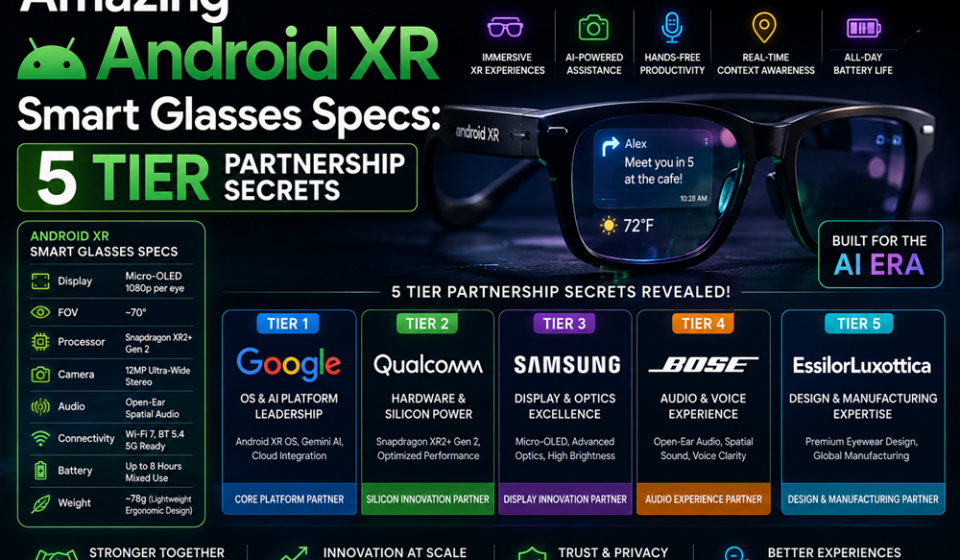
To understand how these daily companion devices function, buyers must analyze the balance of responsibilities divided among the participating brands. The production framework splits its execution across distinct corporate pillars to deliver the first-generation lineup:
| Architectural Component | Core Contributor | Purpose & Functional System Role |
|---|---|---|
| Operating System | Powers the framework via the Android XR platform, providing native integration for Gemini AI and core web services. | |
| Hardware Engineering | Samsung Electronics | Develops the internal physical architecture, managing microphones, exterior cameras, and local wireless chips. |
| Aesthetic Framework A | Gentle Monster | Tailors premium, high-fashion frames built for trendy, disruptive styling lines. |
| Aesthetic Framework B | Warby Parker | Craft classic, value-oriented eyeglasses shapes intended for everyday professional use. |
By separating core technical needs like Bluetooth connectivity and localized audio arrays from the final industrial aesthetic design, the initial Android XR smart glasses specs deliver an item that handles multi-step background commands without looking like a bulky prototyping tool.
Step-by-Step Guide: How the Android XR Multi-Device Loop Connects
Ready to link your wearable assets, activate your cloud voice assistants, and send high-resolution camera data directly to your wrist peripherals? Follow this sequence to configure your personal network safely.
1
Establish the Primary Smartphone Bluetooth Connection
Wireless Initialization
1.Establish the Primary Smartphone Bluetooth Connection:Wireless Initialization.
Turn on your companion smartphone. Access your wireless settings panel to securely pair your eyewear frames with your Android or iOS device using encrypted Bluetooth and Wi-Fi data channels.
2
Activate the Hands-Free Voice Assistant Framework
Step 2
2.Activate the Hands-Free Voice Assistant Framework:Step 2.
Set up your direct interaction phrases. Use the wake greeting “Hey Google” or tap the integrated touch sensor arm on the frame stem to initialize the Gemini AI engine as outlined in the Android XR smart glasses specs.
3
Initialize Camera and Smart Notification Runtimes
Step 3
3.Initialize Camera and Smart Notification Runtimes:Step 3.
Allow the device to process incoming data. Grant system permissions for the frame’s outward-facing cameras to feed visual inputs to your AI assistant for live text translation or situational tracking.
4
Establish Your Wearable Ecosystem Cross-Link
Step 4
4.Establish Your Wearable Ecosystem Cross-Link:Step 4.
Sync your nearby hardware. Route captured photos through your wireless network to instantly view or edit images on an associated smartwatch screen without taking your phone out of your pocket.
5
Run Local Voice Tasks and Automated Transactions
Step 5
5.Run Local Voice Tasks and Automated Transactions:Step 5.
Test real-world capabilities. Issue multi-step natural language commands, such as asking Gemini to summarize missed group text messages or place an online coffee order through third-party food delivery applications.
Expert Hardware Optimization Secrets for Intelligent Eyewear
- Preserve Phone Battery via Intentional Tethering: Because these glasses act as mobile companions rather than standalone compute blocks, offloading heavy processing tasks to your smartphone chip maximizes the glasses’ battery life.
- Leverage the Privacy LED Status Indicator: Always ensure the built-in front LED light is completely unobstructed. The onboard operating system keeps this safety indicator active whenever the camera records to guarantee privacy for those around you.
- Utilize Multi-Turn Audio Translation Overlays: When traveling through regions with foreign signage, use the real-time audio voice matching system to hear translated text spoken in a voice that naturally matches the speaker’s original tone. PCMag
Common Consumer Deployment Mistakes to Avoid
- Expecting Full In-Lens Screen Overlays from First-Wave Audio Specs: Expecting floating heads-up display maps on the base model will lead to disappointment. The initial models are strictly audio-focused; display-integrated versions are planned for a later launch cycle. PCMag
- Restricting Device Compatibility to One Smartphone Platform: Do not assume these wearables only work within a single brand’s walled garden. The underlying Android XR framework natively supports both Android and iOS smartphones to maximize adoption. Engadget
- Muting Essential Ambient Sound Paths in Heavy Traffic: Clamping open-ear audio streams too high when walking through busy intersections can block emergency sirens or vehicle alerts. Keep background volume levels balanced for optimal situational awareness.
Pros and Cons of First-Wave Android XR Audio Glasses
Pros
- Superb Everyday Style Integration: Partnering with fashion houses ensures the frames blend right in with standard designer eyewear. PCMag
- Deep Google Service Ecosystem Links: Offers turn-key connectivity across essential daily platforms like Google Maps, Gmail, and YouTube. Counterpoint Research
- Cross-Platform Flexibility: Works smoothly across both iOS and Android mobile operating systems without arbitrary software locks. Engadget
Cons
- No Visual Heads-Up Display: The lack of visual screens on first-generation models prevents heads-up mapping or video viewing directly on the lenses.
- Requires a Nearby Smartphone: Lacking standalone cellular modems means the glasses must stay tethered to a nearby phone to run cloud processing loops.
Strategic Real-World Consumer Use Cases
- Hands-Free Commuter Navigation Support: Users walking through complex city centers can request live, turn-by-turn walking directions from Gemini, hearing real-time audio cues without staring down at a phone screen. SiliconANGLE
- Instant Foreign Text Translation Assistance: Travelers dining abroad can look directly at a menu while using the built-in frame camera, letting the system instantly read and translate foreign items via conversational audio feedback.
- Seamless Daily Workspace Task Organization: Busy professionals can review incoming calendar invitations, listen to summaries of long text strings, and reply to client emails hands-free while walking between meeting rooms.
Alternative XR Ecosystem Products Available Now
If you want immersive in-glass visual displays or standalone spatial environments right now rather than waiting for future audio-only frames to hit store shelves, several high-performance AR options are currently shipping to consumers:
Immersive Private Screen Wearables
For users seeking a massive virtual screen experience on the go, these tethered spatial computing glasses project clear displays right in front of your eyes:
- XREAL One Pro AR Glasses: A high-performance spatial device built around an advanced optic engine and a 120Hz Full HD Micro-OLED display. It projects a massive 171-inch equivalent screen and features native 3-DoF tracking powered by an internal X1 computing chip, paired with specialized audio tuned by Bose. XREAL One Pro AR Glasses ₹97,520.00 XREAL 4.6 (497)Opens in a new window
- VITURE Luma Pro XR Glasses: This lightweight option brings an ultra-sharp 1200p Micro-OLED display that mimics a 152-inch virtual theater screen. It comes equipped with built-in myopia focus adjustments, electrochromic lenses that darken instantly to block ambient light, and spatial sound tuned by Harman. VITURE Luma Pro XR Glasses ₹88,189.00 VITURE 4.7 (222)Opens in a new window
- RayNeo Air 2s: An exceptionally lightweight 78g design optimized for extended gaming or movie sessions. It packs a 120Hz refresh rate display capable of hitting up to 5000 nits of peak brightness, supported by a four-speaker acoustic layout. RayNeo Air 2s ₹40,824.00 RayNeo 4.9 (48)Opens in a new window
Specialized AR Companions
- XREAL Beam Pro: A dedicated Android-powered touch companion unit featuring dual 50MP 3D cameras designed specifically to record spatial video, offering full access to standard apps on the Google Play Store. XREAL Beam Pro, the AR Glasses Spatial Computing Companion, 3D Cameras, Android 14, Supports All Google Play Store apps, Multiple Spatial Experiences ₹43,707.00 XREAL 4.5 (307)Opens in a new window
Hardware Landscape Summary & Tactical Next Steps
Analyzing the initial Android XR smart glasses specs shows a clear focus on comfortable, fashion-forward design over bulky display hardware. By combining Samsung’s advanced hardware manufacturing with the stylistic expertise of Gentle Monster and Warby Parker, Google has created a highly practical daily accessory. If you are eager to step into wearable spatial audio or require a huge virtual display immediately, explore the available high-refresh XREAL or VITURE smart glasses options to upgrade your tech setup today.
SiliconANGLE
Explore More Google Products & Tools
To see how these new high-speed models fit into Google’s broader software roadmap, check out our comprehensive Google Product Index Categories Hub on the homepage to browse through active enterprise toolsets.
Google Product Index Categories Hub: https://www.google.com/search?q=https://gproductindex.com/
To track how these new tools fit into the wider landscape of active and legacy applications, you can explore our comprehensive Google Products Database Hub right on our homepage.
Google Products Database Hub: https://gproductindex.com
10. FAQ Schema
What are the primary hardware attributes revealed for the new Android XR smart glasses specs?
The initial models prioritize an open-ear audio layout, ditching traditional heavy display glass to minimize frame weight. The frames come equipped with outward-facing cameras, built-in microphones, speaker arrays, and an integrated side-stem touch navigation sensor.
PCMag
How does the dual-design partnership strategy benefit consumers?
By separating fashion design from hardware engineering, the platform accommodates different styles. Gentle Monster provides high-end, premium fashion frames, while Warby Parker supplies timeless, traditional eyeglass designs for mainstream comfort.
Engadget