
The landscape of consumer artificial intelligence has undergone a foundational restructuring. Following major framework unveilings at Google I/O 2026, the tech giant completely re-engineered its premium subscription ladder, introducing a highly specific three-tiered ecosystem. If you have been searching for clarity amid historical name changes like “Gemini Advanced” or “Google One AI Premium,” the new consumer matrix has officially settled into three clear pathways.
Evaluating the structural differences of Google AI Plus vs Pro vs Ultra is no longer just a question of choosing a model size. Google has introduced a foundational shift in how it calculates resource allotments—moving away from rigid daily message count walls and transitioning toward a dynamic, five-hour compute consumption window.
Whether you are a casual writer optimizing daily workflows or a software engineer deploying background agents, finding the exact sweet spot across the Google AI Plus vs Pro vs Ultra subscription tracks is essential to avoid overpaying for raw compute power.
The Problem: The Inefficiency of One-Size-Fits-All Premium Tiers
For nearly two years, consumer AI subscriptions followed a highly predictable blueprint: pay a flat twenty-dollar monthly fee to unlock a flagship model, or remain trapped on a severely rate-limited free tier. This blunt approach created massive economic friction for users. Lightweight productivity hobbyists were forced to pay full price just to access basic spreadsheet tools, while high-volume developers constantly bumped against hourly prompt blocks during critical coding sessions.
[Image comparing the old flat AI subscription model with Google’s new tier-based compute consumption architecture]
The newly established Google AI Plus vs Pro vs Ultra framework directly solves this bottleneck by matching clear user archetypes to proportional price points. Furthermore, by implementing Anthropic-style rolling five-hour compute allocation blocks, the system charges you based on actual backend complexity. A basic text proofread request burns a tiny sliver of your quota, whereas an advanced coding agent execution draws down a larger chunk, ensuring system resources remain perfectly balanced.
Deep Dive: The Core Differences of the Google AI Hierarchy
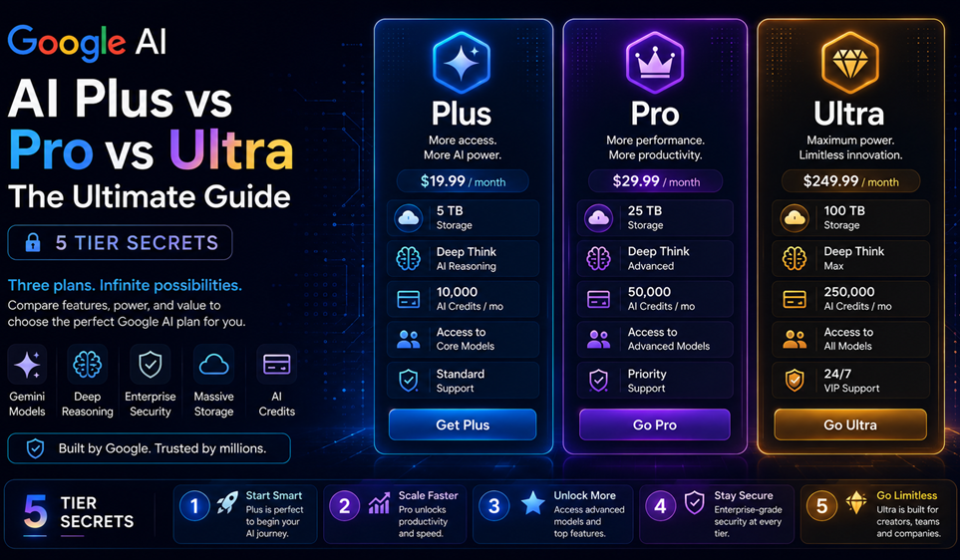
To determine which tier matches your specific daily processing needs, you must analyze the underlying platform constraints, tool access, and integrated ecosystem perks. The active Google AI Plus vs Pro vs Ultra tier structure splits features across these core specifications:
| Plan Level | Monthly Pricing (INR / USD) | Included Cloud Storage | Primary Model & Key UI Features |
| Google AI Plus | ₹399 / $7.99 | 200 GB Storage | Gemini 3 Pro (Capped), AI Inbox in Gmail, 2× basic usage limits. |
| Google AI Pro | ₹1,950 / $19.99 | 5 TB Storage | Gemini 3.1 Pro (1M Context), YouTube Premium Lite, 4× limits. |
| Google AI Ultra (5×) | ₹6,500 / $100.00 | 20 TB Storage | Gemini 3.1 Pro + Deep Think, YouTube Premium Individual, Antigravity access. |
| Google AI Ultra (20×) | ₹19,500 / $200.00 | 30 TB Storage | Uncapped 3.1 Pro, Project Genie, Gemini Spark autonomous agent. |
By separating core infrastructure tasks like standard document editing from advanced developer capabilities like the Jules async coding engine, the Google AI Plus vs Pro vs Ultra matrix prevents casual users from subsidizing high-intensity development clusters.
Step-by-Step Guide: Selecting and Testing Your Best Tier Match
If you are ready to upgrade your personal Google account or adjust an existing storage plan to unlock these modern features, use this sequence to configure your options cleanly.
1.Assess Your Shared Cloud Storage Demand:Account Audit.
Open your active Google One dashboard. Check your current storage consumption metrics across Gmail, Photos, and Drive to pinpoint whether a 200 GB, 5 TB, or multi-terabyte workspace matches your household or business requirements.
2.Evaluate Your Structural Complexity Needs:Step 2.
Determine your prompt intensity. If your workflow relies on massive data ingestion or code auditing, note that you will need at least the 1-million token context window native to the Google AI Plus vs Pro vs Ultra Pro tier or higher.
3.Navigate to the Global Subscription Tray:Step 3.
Go to the main Google One portal (one.google.com). Click directly into the upgraded “Google AI Plans” dashboard to view the localized pricing variations for your specific geographic region.
4.Activate Your Preferred Compute Tier:Step 4.
Select your target option. If you are a standard creator looking for an optimal value bundle, initialize the Google AI Pro tier to instantly unlock the 5 TB storage vault alongside the built-in YouTube Premium Lite membership.
5.Configure Your Manual Model Toggles:Step 5.
Launch the main chat panel. Click the drop-down selector arrow directly next to the active text input pill to manually toggle between 3.1 Flash-Lite, 3.5 Flash, or full 3.1 Pro models to intelligently preserve your 5-hour compute balance.
Expert Optimization Tips for Smart Resource Management
- Intentionally Throttle Tasks with Flash-Lite: Do not allow simple email drafts or quick definitions to burn your high-tier Pro credits. Use your application model dropdown tool to downshift to Flash-Lite for easy tasks, keeping your heavy compute limits reserved for deep coding blocks.
- Maximize Your Bundled Entertainment Perks: If you choose the Pro plan or higher, cancel your standalone streaming packages. The inclusion of YouTube Premium Lite on Pro and the full individual plan on the Ultra tiers can save you significant money on your monthly media bills.
- Isolate Heavy Code Routines in AI Studio: If you are subscribed to the Pro tier or above, make it a habit to build long-form script prototypes directly inside Google AI Studio. This environment provides dedicated endpoints that won’t pollute your standard daily consumer chat histories.
Common Subscription Pitfalls to Avoid
- Assuming Workspace Accounts Can Share Consumer Tiers: Buying a personal Google AI tier expecting it to apply directly to an enterprise business email address will stall your progress. Enterprise teams must utilize the bundled Gemini tiers built directly into Workspace per-seat pricing.
- Forgetting That Usage Limits Automatically Downgrade Models: If you burn through your active 5-hour compute allowance during an intense research session, the app won’t lock you out. Instead, it shifts you down to smaller models until your window resets, which can temporarily lower response depth.
- Purchasing Ultra Tiers for Region-Locked Features: Ambitious autonomous agents like Gemini Spark and Project Genie remain strictly US-only during their initial launch phases. Check your regional availability carefully before committing to the hundred-dollar tier.
Pros and Cons of the Overhauled Google AI Lineup
Pros
- Unbeatable Entry Price Points: Dropping the Plus tier down to $7.99 heavily undercuts traditional alternative platforms, making entry-level AI incredibly accessible.
- Massive Shared Storage Vaults: Providing up to 5 TB of cloud space on the Pro tier creates a highly practical hybrid package for photographers, video editors, and power creators.
- Granular Control Over Performance: The freedom to manually switch between thinking modes and model weights gives professionals total authority over their active workflows.
Cons
- Complex Compute Calculation Rules: The replacement of straightforward message caps with an abstract “compute-used” model makes it tougher to track exactly when you will trigger an automatic model downshift.
- Significant Price Jumps on Ultra Plans: Transitioning from the $19.99 Pro tier straight into the $100 and $200 Ultra plans represents a steep investment cliff intended almost exclusively for enterprise developers.
Real-World Productivity Use Cases
- Hobbyist Content Creation & Organization: Independent creators utilize the affordable Plus tier to run streamlined Deep Research queries, organizing initial scripts inside NotebookLM while taking advantage of the expanded 200 GB drive space for channel backup assets.
- Professional Web Development & Asset Management: Systems administrators and web engineers select the Pro tier to run heavy code validation passes using the 1-million token context window, using the 5 TB storage pool to hold server configurations.
- Enterprise Agent Architecture Simulation: Advanced software architects deploy the $200 Ultra tier to run autonomous browser agents across parallel windows, leveraging the massive 25,000 monthly AI credits to simulate complex multi-app data pipelines.
Framework Value Summary & Final Verdict
Navigating the Google AI Plus vs Pro vs Ultra breakdown highlights a clear strategy from Google: matching your specific processing load to the right tier ensures maximum efficiency. For the vast majority of consumers and power creators, the Pro tier at $19.99 represents the undisputed sweet spot, smoothly balancing deep model access with an expansive 5 TB storage package and bundled entertainment perks. Start by auditing your storage needs, test your processing intensity via a free trial, and utilize manual model shifting to keep your compute pipelines running at peak performance.
Explore More Google Products & Tools
To see how these new high-speed models fit into Google’s broader software roadmap, check out our comprehensive Google Product Index Categories Hub on the homepage to browse through active enterprise toolsets.
Google Product Index Categories Hub:
https://www.google.com/search?q=https://gproductindex.com/
To track how these new tools fit into the wider landscape of active and legacy applications, you can explore our comprehensive Google Products Database Hub right on our homepage.
Google Products Database Hub:
10. FAQ Schema
What happens if I go over my compute limits on the Google AI Pro plan?
When your complex prompts hit the ceiling of your rolling 5-hour compute allocation block, the app will automatically downshift your workspace to run on smaller, high-speed models like Gemini 3.5 Flash or Flash-Lite until your quota resets.
Can I share my Google AI Plus vs Pro vs Ultra benefits with family members?
Yes. Family sharing functionality is standard across all three subscription tiers. The primary account owner can share their model access and pooled cloud storage space with up to five household members at no additional cost per seat.
Is YouTube Premium included in all of the new Google AI plans?
No, the entertainment bundles vary across the matrix. The Plus plan does not feature a media bundle, the Pro plan includes a YouTube Premium Lite individual membership, and the Ultra plans include the full, unrestricted individual YouTube Premium subscription.